
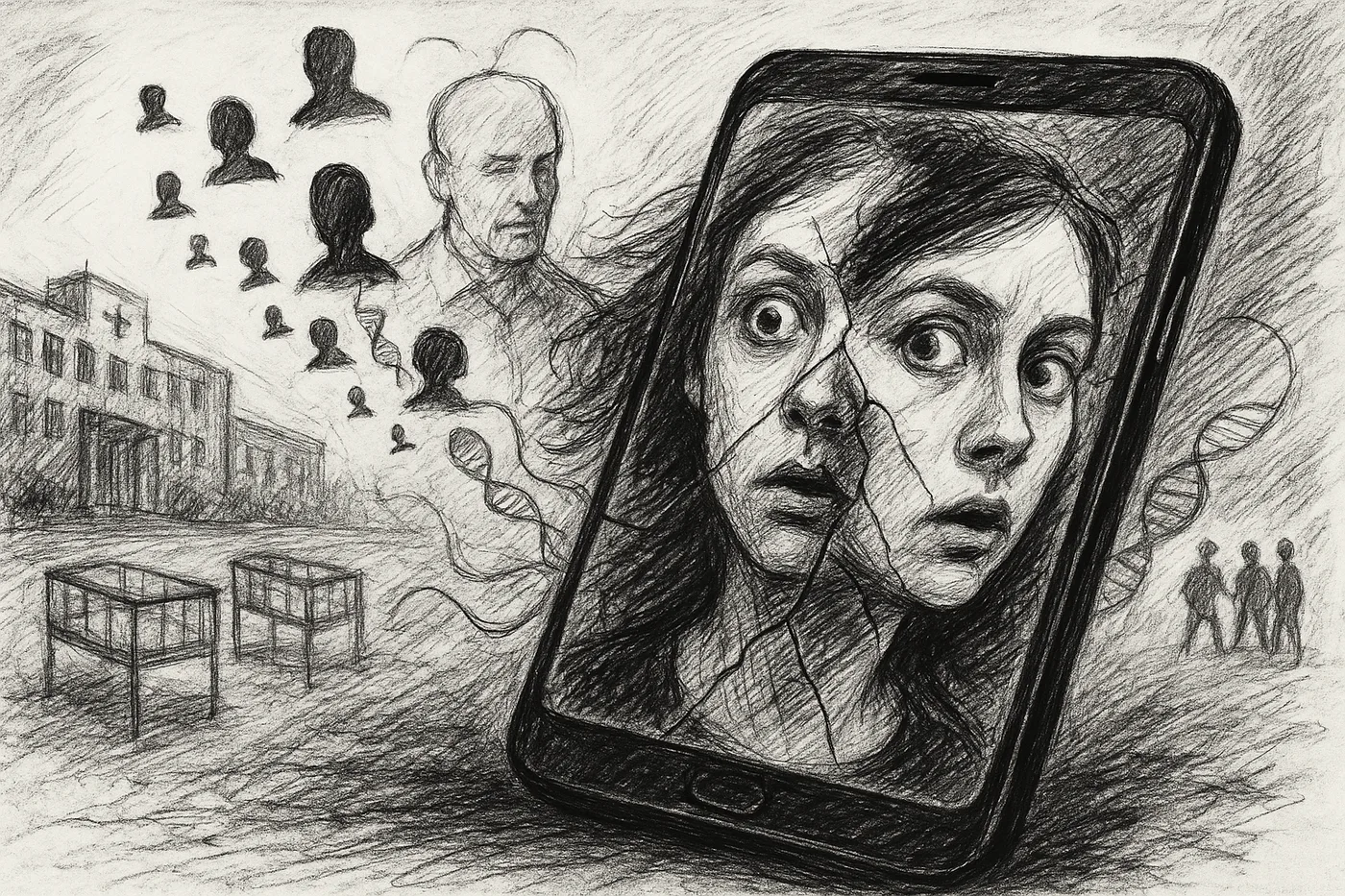
TLDR: In Georgia, a decades-long baby trafficking scheme turned hospitals into crime scenes, stealing as many as 100,000–120,000 newborns from their mothers and selling them into secret adoptions—lies papered over with fake death notices, falsified records, and deep cultural shame around infertility and non-kin adoption. HBO Max’s Stolen Children follows two of the most surreal human threads: journalist Tamuna Museridze, who discovered her birth father had been on her Facebook friends list for years, and identical twins Amy and Ano, stolen at birth and reunited after one saw the other in a TikTok video and recognized her own face. Their stories unlocked a national reckoning: Tamuna’s Facebook group “Vedzeb” (“I’m Searching”) has grown to 230,000 members, reunited hundreds of families, and exposed how everyday people—with screenshots, DNA kits, and social media—are rebuilding the history their institutions say is “lost.” The film isn’t just dark true crime; it’s a study in how ordinary Georgians, raised on silence and stigma, are choosing painful truth over comforting lies and using the very platforms built for distraction to answer the oldest question: Who am I, really?
That's not a Netflix pitch. That's the real story of Georgian journalist Tamuna Museridze, who spent years searching for her birth family, only to discover her father was already on her friends list.
And somehow, that's not even the wildest part of Georgia's stolen children story.
Because while Tamuna was scrolling Facebook, two young women were having their own "wait, what?" moment on TikTok. Amy Khvitia posted a video of herself with blue hair getting her eyebrow pierced. A friend sent the clip to another 19-year-old, Ano Sartania, hundreds of kilometres away in Tbilisi, joking that the girl looked just like her.
Ano watched it and realized: this wasn't just a look-alike. This was a mirror.
They turned out to be identical twins, stolen at birth from a Georgian hospital, sold to separate families, and told they were only children.
This is the human side of an adoption trafficking scandal that ran from the Soviet era into the 2000s and may have taken as many as 100,000–120,000 babies in a country of just 3.5 million people. It's the story sitting underneath the new HBO Max documentary Stolen Children, which premiered December 12, 2025.
When hospitals became crime scenes
The Stolen Children documentary, directed by Martyna Wojciechowska and Jowita Baraniecka, follows Tamuna's investigation and the viral reunion of twins Amy and Ano. On screen, you see the shocking scale: hospitals declaring healthy babies dead, mothers given fake bodies or no documents at all, children sold in illegal adoptions at home and abroad.
But a scandal this big doesn't survive for five decades just because a few doctors were evil. To really see it, you have to understand something messier: in post-Soviet Georgia, adoption wasn't just private. It was shameful.
Soviet-era ideas about bloodlines meant biological kinship was everything. Orphanhood and non-kin adoption were treated as taboo. Many adopted children were never told the truth about their origins.
At the same time, there was crushing pressure on couples to have children. Infertility, miscarriage, pregnancy loss—all sat under a heavy blanket of silence. If you couldn't have a baby, you didn't talk about it. You whispered, you improvised, you looked for quiet solutions.
That's the market. Then came the middlemen.
Across at least 20 hospitals, doctors, nurses, administrators and even taxi drivers realized there was money to be made. From roughly the 1950s up to 2005, healthy newborns were taken from mothers in labor or recovery, declared dead—sometimes with a staged corpse, sometimes with nothing but a sentence—and sold to desperate would-be parents who often didn't know the full story.
It's the perfect business model for hospital corruption: high demand, deep trust in doctors, layers of cultural stigma, and almost no oversight.
One Facebook group cracks it all open
Tamuna's story starts quietly. In 2016, after the woman who raised her died, she found a birth certificate with her own name and the wrong date of birth. That tiny error cracked everything open.
She asked questions. She hit walls. So in 2021, she did something deceptively simple: she opened a Facebook group called Vedzeb—"I'm Searching."
It exploded. More than 230,000 members joined. Up to 100,000 mothers registered as searching for children they'd been told were dead. Hundreds of families have already been reunited.
What started as "maybe I was adopted" turned into "this is one of the biggest child trafficking scandals modern Europe has seen."
And then came the twist. After years of digging, DNA tests and tips finally led Tamuna to her biological mother, who at first denied everything. Eventually she admitted the truth and gave Tamuna a name: her father, Gurgen Khorava.
Tamuna searched Facebook. He had already been her friend for three years.
It is both absurd and deeply moving: a woman who didn't know who she was, and a man who didn't know his daughter was already in his feed.
The twins who kept meeting each other on screens
At 12, Amy sat near the Black Sea watching Georgia's Got Talent on TV. A girl danced the jive and looked exactly like her. The adults shrugged. Everyone has a doppelganger.
Seven years later came that TikTok video. Ano's friend sent it to her: "This girl looks just like you."
They messaged. They met at a metro station in Tbilisi. They realized they shared not only a face and a voice, but a birth hospital, a year, and a deep sense that something in their lives had never quite added up.
Digging into their paperwork, they found wrong birthdates, adoptions a few weeks apart, and a hospital later implicated in newborn trafficking. Eventually they met their biological mother, who had been told both babies died after she fell into a coma following complications during birth.
Years later, standing in front of two very alive young women, she said that meeting Amy and Ano gave her life new meaning.
Today, the twins use the same tools that found each other—TikTok, Facebook, DNA kits—to help others caught in Georgia's stolen children scandal do the same. Tamuna, now honored on the BBC's 100 Women list and by Georgia's president with a Medal of Honor, has handed over all her evidence to authorities but continues her work through Vedzeb.
Meanwhile, official investigations move at glacial speed. A 2022 Ministry of Internal Affairs probe spoke to more than 40 people, then stalled. Officials say cases are "very old" and "historic data has been lost." The prime minister insists Georgia leads the world in fighting trafficking. The Facebook group quietly keeps adding new members.
If this were satire, "historic data is lost" would be the punchline. In real life, people are using screenshots, family photos, and DNA tubes to rebuild the history their institutions misplaced.
The messy work of healing
Reunions are not fairy-tale endings. They are messy, human middle chapters. Biological mothers carry decades of grief and crushing shame. Adult children juggle love for the parents they've known with anger at a system that lied to everyone. Some families embrace the truth; others keep it quiet to avoid the stigma that still clings to adoption in post-Soviet Georgia.
In Vedzeb, people act as their own detectives: trading hospital names, scanning old records, crowdfunding DNA tests. They're also learning new sentences: "I was stolen." "My child was stolen." "My adoption was illegal."
Georgia isn't uniquely cursed. Other countries—from Spain to Latin America to elsewhere in the former Soviet bloc—have their own versions of stolen children. This is what happens when shame, profit and unchecked power share a room.
The surprising part isn't that it happened. It's that so many people, raised on silence, decided they would rather live with painful truth than comfortable lies.
Your move
So here we are: a documentary trending on HBO Max, a twin reunion built on TikTok, a father discovered in a Facebook friends list, and tens of thousands of people still waiting for their own "mirror moment."
On one side: hospitals that turned birth into a business, investigations that barely move, officials saying the data is gone. On the other: a Facebook group of 230,000 people comparing notes, young women turning viral fame into community work, strangers sharing DNA results in the comments.
If you watch Stolen Children as just dark true crime, you'll miss the point. It's really a story about how far humans will go to answer the simplest question: "Who am I, really?"
Watch the Stolen Children documentary on HBO Max. Then come back and share your thoughts in the comments: What struck you most—the scale of the scandal, or the creativity of the reunions? And what do you make of a world where, against all odds, you might find your twin on TikTok or your father in your Facebook friends list?