
TLDR: Champagne sparklers ignited a foam ceiling in a Swiss bar, unleashing a flashover that killed 40 in 10 seconds—a preventable tragedy that keeps repeating because nightlife economics prioritize aesthetics over fire safety standards proven for decades.
How physics and party culture collided in a basement bar, turning celebration into a 10-second inferno
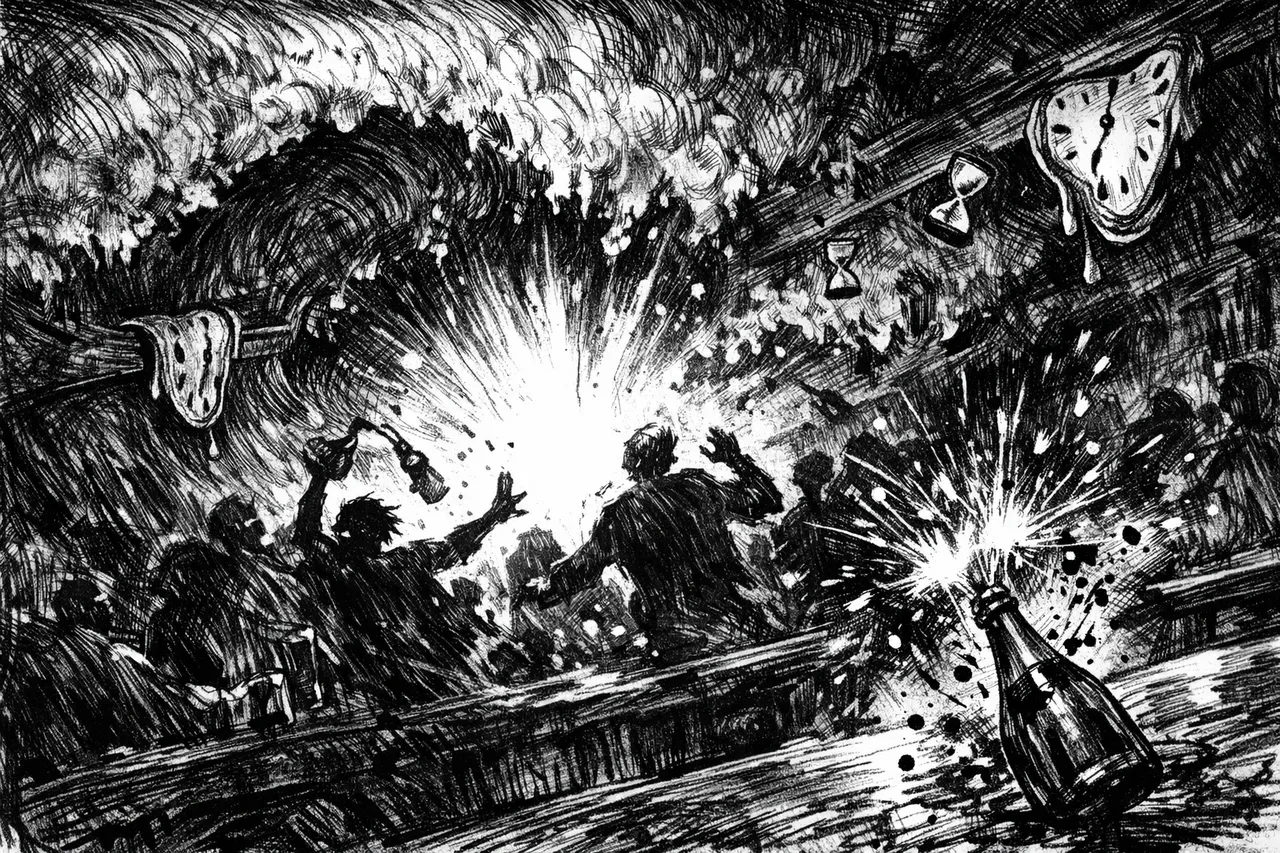
Picture this: champagne bottles gliding through a packed New Year's party, each topped with a sparkler throwing off festive sparks. Instagram gold. To a fire investigator, it's someone waving a blowtorch under a ceiling made of kindling.
At Le Constellation bar in Crans-Montana, Switzerland, that gap between "celebration" and "combustion hazard" collapsed in approximately 10 seconds on January 1, 2026. Forty people died. Another 119 were injured, many with severe burns. This isn't a story about freak accidents. It's about predictable physics meeting predictable party habits, and how the time from "first flame" to "no escape" can be shorter than a song chorus.
What Actually Happened (What We Know For Certain)
At 1:30 AM, the basement-level bar was packed with revelers, mostly young and international, ringing in 2026. According to Valais Attorney General Beatrice Pilloud, initial investigations point to a specific sequence: a waitress, carried on a barman's shoulders, hoisted champagne bottles fitted with lit sparklers. The sparks were centimeters from a wooden ceiling lined with acoustic foam. The foam ignited.
Within seconds, flames spread across the ceiling. Pilloud described the progression as having "explosive rapidity." Eyewitness videos and photos captured by French media show a small ceiling flame that grew into a full inferno in roughly 10 seconds. Survivors described a terrifying bottleneck at the single narrow staircase leading from the basement to ground level. Some escaped by smashing plexiglass windows. Others didn't make it out.
Police arrived within two minutes of the first alert. The response was massive: 150 personnel, 10 helicopters, 40 ambulances, makeshift triage centers in neighboring bars and a bank branch. Switzerland declared five days of national mourning.
Now for the part most headlines skip: why this specific setup erased any chance of survival.
Wait, What? Flashover Explained Without the Jargon
Flashover is the moment a room stops burning in one spot and starts burning everywhere at once. It's not an explosion, though survivors often describe it that way. It's a thermal tipping point.
Here's what happens. Fire heats the ceiling first. Smoke and hot gases collect in an upper layer. As temperatures climb past 900 to 1,100 degrees Fahrenheit, every combustible surface in the room reaches its ignition point simultaneously. Floors, walls, furniture, people. The entire space erupts in flame.
Fire consultant Stephen MacKenzie told CNN how long flashover takes to develop: "Seconds."
The three ingredients that made Crans-Montana inevitable:
Fuel. The ceiling featured pyramid-shaped acoustic foam, likely untreated polyurethane. When heated, this material releases flammable gases before it even flames, a process called pyrolysis. Add wooden furnishings and bodies generating heat, and you have a fuel load primed for rapid combustion.
Heat. Sparklers burn at 1,200 to 2,000 degrees Celsius. That's hotter than most blowtorches. People think of sparklers as harmless because they're small and familiar. But they throw molten metal particles and radiate intense heat. Held inches from foam, they don't just catch it on fire. They trigger instant pyrolysis, flooding the ceiling layer with combustible gases.
Enclosure. Basements concentrate heat. Low ceilings trap hot gas layers. Limited ventilation means nowhere for the energy to escape. The heat radiates back down onto surfaces and people, accelerating ignition.
The Escape Window That Didn't Exist
Eyewitness accounts describe a surreal compression of time. One moment, a small flame on the ceiling. The next, a wall of heat and smoke. Emma and Albane, survivors who spoke to French broadcaster BFMTV, said evacuation was "very difficult" because the escape route was narrow and the stairs "even narrower."
This is where flashover becomes personal. Your escape window isn't measured in minutes. It's measured in breaths.
At flashover temperatures, radiant heat causes severe burns on exposed skin in seconds. Superheated gases scorch lungs. Visibility drops to zero. Dr. Robert Larribau, head of emergency care at Geneva University Hospital, described the injuries as "severe burns predominantly affecting exposed body areas such as the face, neck, and upper limbs," with "critical inhalation injury due to intense radiant heat and superheated gases."
Even firefighters in full protective gear struggle to survive flashover conditions, according to the National Fire Protection Association. Civilians have near-zero chance once that threshold is crossed. Add a crowd surge at a single staircase, darkness, smoke, and panic, and the physics become unsurvivable.
The Foam Factor: A Quiet Villain Returns
Acoustic foam dampens sound. But when installed on ceilings, especially in untreated form, it becomes the largest ignition surface in the room. Investigators are examining whether the foam at Le Constellation complied with Swiss fire regulations.
Swiss law requires non-flammable furnishings in public venues, smoke ventilation systems, and multiple exits for spaces holding more than 200 people. The bar passed annual or bi-annual inspections. But passing inspection doesn't guarantee safe conditions if materials change, occupancy limits get ignored, or event practices introduce new hazards.
Wait, what? We learned this lesson 23 years ago.
In 2003, The Station nightclub fire in Rhode Island killed 100 people when pyrotechnics ignited acoustic foam on walls and ceiling. The pattern: confined space, foam, ignition source, rapid flashover, mass casualties. Former Boston Police Commissioner Ed Davis, speaking to CNN, said the Crans-Montana blaze "immediately reminded" him of The Station.
Same physics. Same materials. Same outcome. Different year, different country, different victims.
Why does this keep happening? Nightlife venues optimize for vibe: acoustics, lighting, Instagram moments like sparkler-topped bottles. Safety upgrades are invisible and expensive. Retrofitting sprinklers or replacing foam with fire-retardant materials costs real money. Bottle sparklers cost nothing until they kill 40 people.
What Actually Prevents Flashover (The Unglamorous Stuff That Works)
Sprinklers. They're not about putting out fire. They cool the air and wet surfaces, preventing the thermal buildup that triggers flashover. Fire experts told The New York Times that sprinklers could have stopped this fire from reaching the tipping point. Le Constellation had none.
Fire-rated materials. Ceilings must be non-combustible or fire-retardant. Period. M1-rated foam costs more than M4 foam. It costs less than 40 funerals.
Ban indoor sparklers. Especially in basements, low ceilings, foam-lined spaces, and crowded conditions. Not to kill the vibe. Because physics doesn't care about your aesthetic.
Multiple exits with clear signage. Doors that open outward. Crowd management that assumes panic, not orderly lines. Switzerland requires multiple exits for venues over 200 capacity. Survivors described escaping via one narrow staircase or by smashing windows.
The Accountability Gap
No arrests have been made. Attorney General Pilloud stated the investigation will determine if safety standards were met and whether negligence played a role. If criminal liability is found, charges could include negligent homicide and negligent bodily injury.
The deeper question isn't about individual blame. It's about systemic incentives. Economic pressure favors cheap materials and festive spectacle over invisible prevention. Enforcement varies across Switzerland's decentralized cantons. Owners optimize for profit and atmosphere. Inspectors check boxes. And every few years, somewhere, the physics catch up.
Jacques Moretti, one of Le Constellation's owners, told Swiss media the venue had been inspected "three times in ten years" and "everything was done according to the standards." This may be true. Standards on paper and standards in practice are different animals.
The Math We Keep Ignoring
Here's the final, uncomfortable insight from Crans-Montana: modern nightlife creates conditions where the time from "first spark" to "mass casualty event" can be shorter than the time it takes to realize something's wrong.
The physics aren't new. The Station nightclub proved this in 2003. The 1990 Happy Land social club fire in New York killed 87 from a single match. The 2013 Kiss nightclub fire in Brazil killed 242. Foam, crowds, ignition sources, inadequate exits. Repeat.
Switzerland will revise its fire codes. They always do after disasters. But prevention works better than memorials. Sprinklers prevent flashover. Fire-rated materials buy escape time. Multiple exits save lives when panic hits. These aren't mysteries. They're engineering problems we solved decades ago.
The question is whether we'll update our codes, our venues, and our party culture before the next tragedy, or whether we'll keep writing these stories until we finally learn what fire science has been screaming at us for decades: in the right conditions, celebration and catastrophe are separated by about 10 seconds and a cheap piece of foam.