
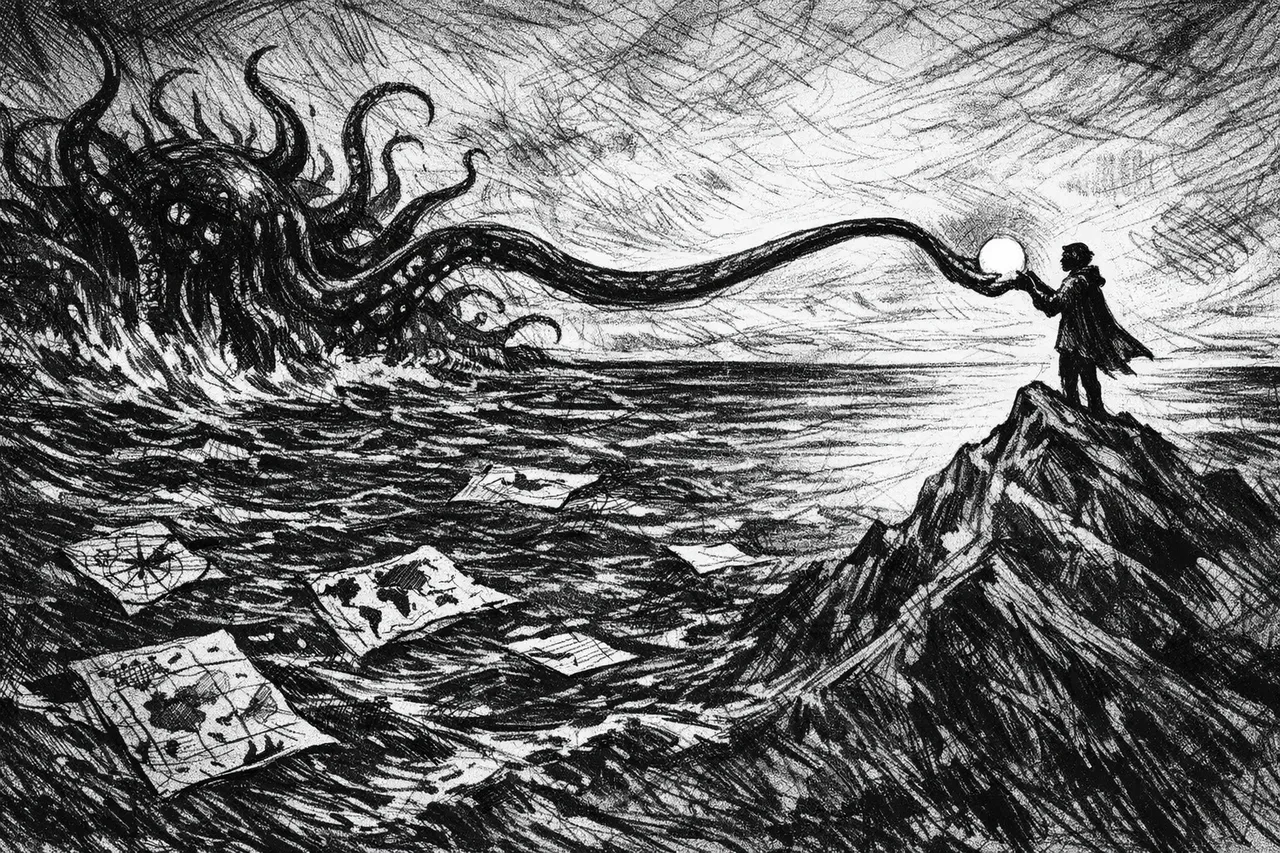
TLDR: After 20 years of negotiation, the High Seas Treaty entered into force this month, creating enforceable governance for two-thirds of the ocean's surface beyond any country's 200-mile limit. While headlines focus on marine parks, the treaty's most profound shift is a hidden equity clause requiring wealthy nations to share profits and data from ocean discoveries with developing countries—including landlocked nations. The next year's implementation will determine whether this becomes functional protection or remains symbolic paperwork.
Imagine discovering that your favorite public park has never actually had a ranger. No one checks for permits, no one stops the littering, and if someone decides to bulldoze the meadow, that's just freedom. For half the planet's surface, that park is the ocean. And as of January 17, 2026, we finally hired a ranger.
The High Seas Treaty entered into force this month, turning two decades of diplomatic negotiation into actual international law. If you're thinking, "Wait, I didn't know most of the ocean had no rules," you're not alone. Let's unpack what just changed, why the equity story hidden inside this treaty matters more than the headlines suggest, and whether all this momentum survives contact with reality.
The Big Map Problem: What Are "High Seas," Exactly?
Picture a beach. Walk into the water, and for the first 12 nautical miles, you're in territorial sea, sovereign territory like dry land. Keep swimming to 200 nautical miles, and you're in a country's Exclusive Economic Zone, where they control the fish and oil but not the water itself. Beyond that? You've hit the high seas.
These areas beyond national jurisdiction cover about 235 million square kilometers: two-thirds of the ocean's surface and roughly 90% of its volume. That's half the planet, belonging to no one and everyone simultaneously. Until now, the only real governance came from the 1982 UN Convention on the Law of the Sea, which gave nations freedom to navigate, fish, and research but said remarkably little about protecting biodiversity. The result was a planet-sized commons with no one officially tasked with protecting it.
"No One Owns It" Isn't the Same as "No One Uses It"
For centuries, "freedom of the high seas" sounded noble. In practice, it meant whoever showed up with the biggest boat and fastest tech made the rules. Fishing fleets from wealthy nations vacuumed up stocks near developing countries' waters. Research vessels collected rare organisms from the deep sea, patented their genes, and locked up the data. Mining companies plotted to carve up the seafloor while the rest of us were still figuring out what lives down there.
The tragedy wasn't just environmental; it was structural. The old system rewarded extraction and punished cooperation. The High Seas Treaty doesn't end that freedom. It adds the guardrails we pretended weren't necessary.
The Governance Gap: How We Got Here
The UN Convention on the Law of the Sea is basically the constitution for the oceans, but the biodiversity chapter was left blank. For twenty years, countries argued about who should fill it. The formal process finally launched in 2017, followed by five grinding rounds of negotiations from 2018 to 2023, including a COVID pause that felt like it might kill the whole thing.
Then something surprising happened. On March 4, 2023, negotiators finalized the text. On June 19, 2023, it was adopted by consensus at UN Headquarters. It opened for signature that September, drawing 145 signatories. The race to 60 ratifications was on. Morocco deposited the 60th instrument on September 19, 2025, triggering a 120-day countdown. Seventy-five countries have now ratified, but here's the twist: the United States signed but still hasn't ratified, which means the world's largest ocean stakeholder is technically a guest at its own party.
So What Did the Treaty Actually Create?
The treaty isn't one big rule. It's four separate but linked systems that finally treat the high seas as a shared responsibility rather than a free-for-all.
Marine Protected Areas on the High Seas
For the first time, countries can formally propose marine protected areas in international waters. There's a review process, scientific benchmarks, and coordination with existing bodies that regulate fishing, shipping, and mining. With less than 2% of the high seas currently protected, this matters for hitting the global 30×30 goal: protecting 30% of oceans by 2030. Bloomberg Ocean Initiative and the Minderoo Foundation have already pledged millions to help countries develop proposals. The proof will be whether big fishing nations actually respect boundaries they can't veto unilaterally.
Environmental Impact Assessments
The treaty requires mandatory environmental impact assessments for activities that could significantly harm marine ecosystems: deep-sea mining, large-scale fishing experiments, seabed cabling. That sounds revolutionary, but the genius isn't in banning things. It's in forcing companies and countries to "show their work" before they break stuff. An EIA doesn't automatically stop a project. It just makes "move fast and break ecosystems" a lot harder to justify.
Marine Genetic Resources: The Sleeper Equity Story
This is the treaty's hidden treasure clause. Marine genetic resources (the genetic material from ocean life that could lead to new medicines, enzymes, or biotech) have historically been "finders keepers." A research ship from a wealthy nation would scoop up specimens, sequence their DNA, patent the promising bits, and share nothing.
The treaty flips that script. Now, benefits (both money and data) must be shared. Developing nations, small island states, and even landlocked countries get guaranteed access and upfront payments into a trust fund. It's like the ocean's version of a profit-sharing agreement, except the profits are knowledge and the shareholders include nations that have never seen the sea. The treaty even covers digital sequence information, which means you can't just upload the genome and claim it's separate from the organism.
This is the story getting buried under conservation headlines. While everyone focuses on marine parks, the treaty is quietly rewriting who profits from ocean discoveries.
Capacity-Building and Technology Transfer
Rules are meaningless if only a handful of countries can afford to implement them. The treaty creates mandatory capacity-building and technology transfer: web-based tools for monitoring, simplified funding applications, direct support for creating regional proposals. Developed countries make upfront payments when the treaty takes effect to jumpstart this work.
The skeptical lens here is healthy: these provisions are only as good as the funding and political will behind them.
What Ownership Looks Like Without Sovereignty
The treaty answers the title question with a paradox: no one gains sovereignty, but everyone gains shared responsibility. The high seas remain the "common heritage of humankind," but that heritage now comes with a board of directors, a scientific advisory panel, and a rulebook for settling disputes.
Ownership in this context means access and benefit, not flags and fences. It's about who gets a seat at the table when scientists propose a protected area, who profits when a deep-sea microbe yields a cancer drug, and who pays when an oil spill drifts across five jurisdictions. The power shift is subtle but profound: from "freedom-first" to "freedom with stewardship."
The Next Year Is the Real Test
The treaty entered into force this month, but the real drama starts now. The first Conference of Parties must convene by January 2027, and a Preparatory Commission is already grinding through three sessions of planning: institutional arrangements, financing mechanisms, secretariat location, scientific body composition.
These meetings determine whether the treaty becomes a functioning system or a symbolic gesture. Will the clearing-house mechanism actually share data transparently? Will the special fund disburse money quickly enough to matter? Will observer NGOs and Indigenous groups have real voice or just seats in the back? And will the United States ratify, or remain the world's most influential spectator?
A Commons Worth Growing Up About
We didn't "save the ocean" this month. We finally admitted that a commons covering half the planet needs grown-up governance. The High Seas Treaty is less a victory lap and more a to-do list with teeth, if we fund it, staff it, and defend it from inevitable attempts to weaken its rules.
The treaty gives us a framework for the debates ahead: who gets the data, who profits, who protects what we don't yet understand. Whether we use it fairly is the next, much harder, chapter.