
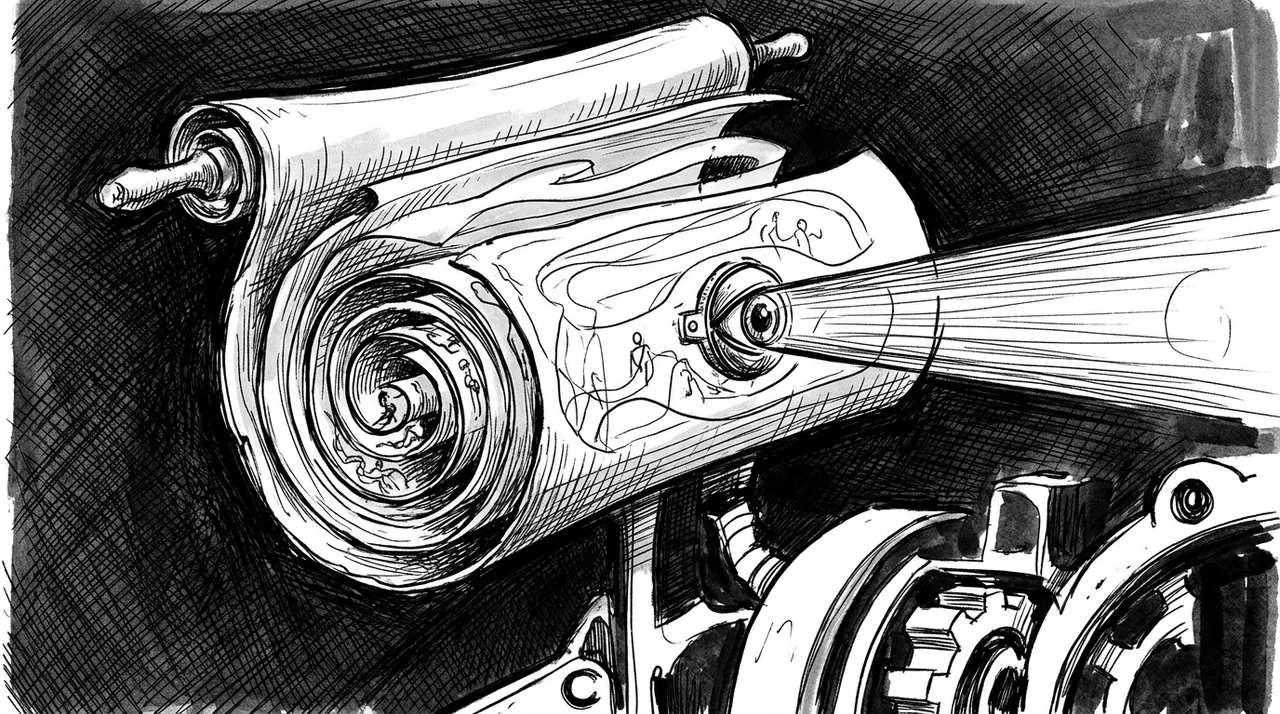
TLDR: Researchers have virtually read the first sealed Herculaneum scroll end to end—without opening it—by combining synchrotron X-ray scans, virtual unwrapping, machine learning, and papyrology. The result is a nearly complete Stoic treatise on ethics from PHerc. 1667, and researchers say the same method could unlock many of the 1,000+ still-sealed scrolls from the Villa of the Papyri.
In late June 2026, researchers announced they had read an ancient scroll. Without opening it.
You've probably seen the shorthand: AI decoded a Vesuvius scroll. As headlines go, accurate but thin.
The announcement was more specific. Researchers recovered all surviving text from Herculaneum scroll PHerc. 1667, the first sealed Herculaneum scroll to be virtually unwrapped and read end to end. The object itself was a crushed, carbonized husk that scholars could barely touch without destroying. Calling this "AI decoding" is like calling surgery "a knife job."
Underneath the buzzword summary is a careful, hard-won method that could help unlock an unreadable ancient library.
The News, Precisely Stated
PHerc. 1667 came from Herculaneum, the Roman town buried in the 79 CE eruption of Mount Vesuvius. In June 2026, researchers recovered nearly 1 meter of writing spread across about 20 columns.
"All surviving text" is the key phrase. Physical unrolling attempts in the 19th century destroyed more than half the scroll's contents. Scholars read what remained in the preserved inner core: roughly 20 columns, continuously, end to end, through virtual means. No one had done that before with a sealed Herculaneum scroll.
Step One: Do Not Open the Book
The Herculaneum scrolls are not crisp manuscripts with tidy lettering inside. They are charred, compressed, brittle, and strange. For generations, scholars faced an ugly choice: leave them sealed and unread, or open them and risk turning a 2,000-year-old document into papyrus confetti.
That made the core problem more fundamental than translation. Before anyone could read the text, someone had to figure out how to access writing trapped inside carbonized layers that crumble when touched. Refusing to open the book turned out to be the key methodological insight of the last two decades.
What Actually Made the Reading Possible
No single tool solved this. Researchers built a chain.
Teams started with high-resolution phase-contrast X-ray microtomography, a CT-style scan of the rolled papyrus. They acquired scans at the European Synchrotron Radiation Facility in Grenoble and at Diamond Light Source in the UK, facilities precise enough to distinguish internal layers without touching the scroll.
Then came virtual unwrapping: software that separates and flattens those packed inner layers in digital space. This technique grew from more than two decades of work by Brent Seales and EduceLab at the University of Kentucky, developing ways to read damaged texts without physically opening them.
Then machine learning entered. Researchers trained models to detect faint traces of carbon ink against carbonized papyrus, two things that can look nearly identical. Not the kind of job you hand to a chatbot. The models required specific training on a visual problem with no clear precedent.
Then papyrologists read what the models found. Federica Nicolardi of the University of Naples Federico II led both the model development and the scholarly interpretation. The National Library of Naples, custodian of the Herculaneum collection, grounds the whole effort in conservation and institutional continuity.
The chain holds because every link matters: imaging physics, virtual unwrapping, machine learning, and classical scholarship. Remove one and the method collapses. Seales said at the announcement: "The tech actually does look like magic, but it's not. It's the remarkable means to a higher calling: the restoration of lost voices from the ancient world."
An Ancient Argument, Speaking Again
The recovered text deserves attention beyond the method. PHerc. 1667 contains a Stoic philosophical treatise on ethics, covering human knowledge, the difference between good and evil, and the importance of acting from reason rather than impulse. The Greeks called this practical wisdom: phronesis. The scroll argues against letting passion override reason. That argument still has an audience.
The scroll references Aristocreon, the nephew of Chrysippus, and scholars date the text to the 2nd or 3rd century BCE. Its author remains unknown, but experts suspect Chrysippus himself wrote it. Scholars know Chrysippus almost entirely through later quotations and summaries. A direct source text gives classicists something rarer: the original argument.
The Library Behind the Scroll
PHerc. 1667 is one scroll. The Villa of the Papyri at Herculaneum yielded over 1,000 carbonized scrolls when excavators found the site in the 1750s, the only surviving ancient library of its kind from the Greco-Roman world. Most of it remains sealed.
The same physical-opening attempts that destroyed the outer layers of PHerc. 1667 left the collection's inner core intact. Virtual methods are now the only path to reading those scrolls without losing them. The Vesuvius Challenge, launched in 2023 by Seales, Nat Friedman, and Daniel Gross, has already produced progress on two additional scrolls: more than 70 columns from PHerc. 172, part of Philodemus' On Vices, and a title identification in PHerc. 139, Philodemus, On Gods, Book 8. A $1 million prize awaits the first team to virtually read another complete scroll by June 2027.
Researchers describe the method as repeatable and scalable. One decoded scroll, in that framing, becomes a doorway into a library that stayed silent for nearly two millennia.
Is This an AI Story?
Machine learning mattered. Full stop. But surrounding it were synchrotron facilities in France, conservation work in Naples, virtual unwrapping built over two decades in Kentucky, and classicists in Italy interpreting results with tools they would apply to any papyrus. Crediting a machine with "solving" the scrolls flattens two decades of human infrastructure into a single buzzword.
Seales told the Washington Post he expects the conversation to shift from technology to the texts. That shift, from computer science to papyrology, from method to meaning, is where the story picks up.
PHerc. 1667 is the first complete virtual reading. Researchers say the method scales to other scrolls. The library is still waiting.