
TLDR: Japan's new AI monk Buddharoid addresses a crisis of 20,000 understaffed temples by generating live Buddhist counsel from centuries of scripture, though it cannot practice, feel, or take vows. The experiment reveals a deeper tension: while Buddhism's concept of "emptiness" complicates the question of authenticity, the robot risks replacing human spiritual formation and accountability with scalable algorithmic performance—leaving us to ask what wisdom still requires a living witness.
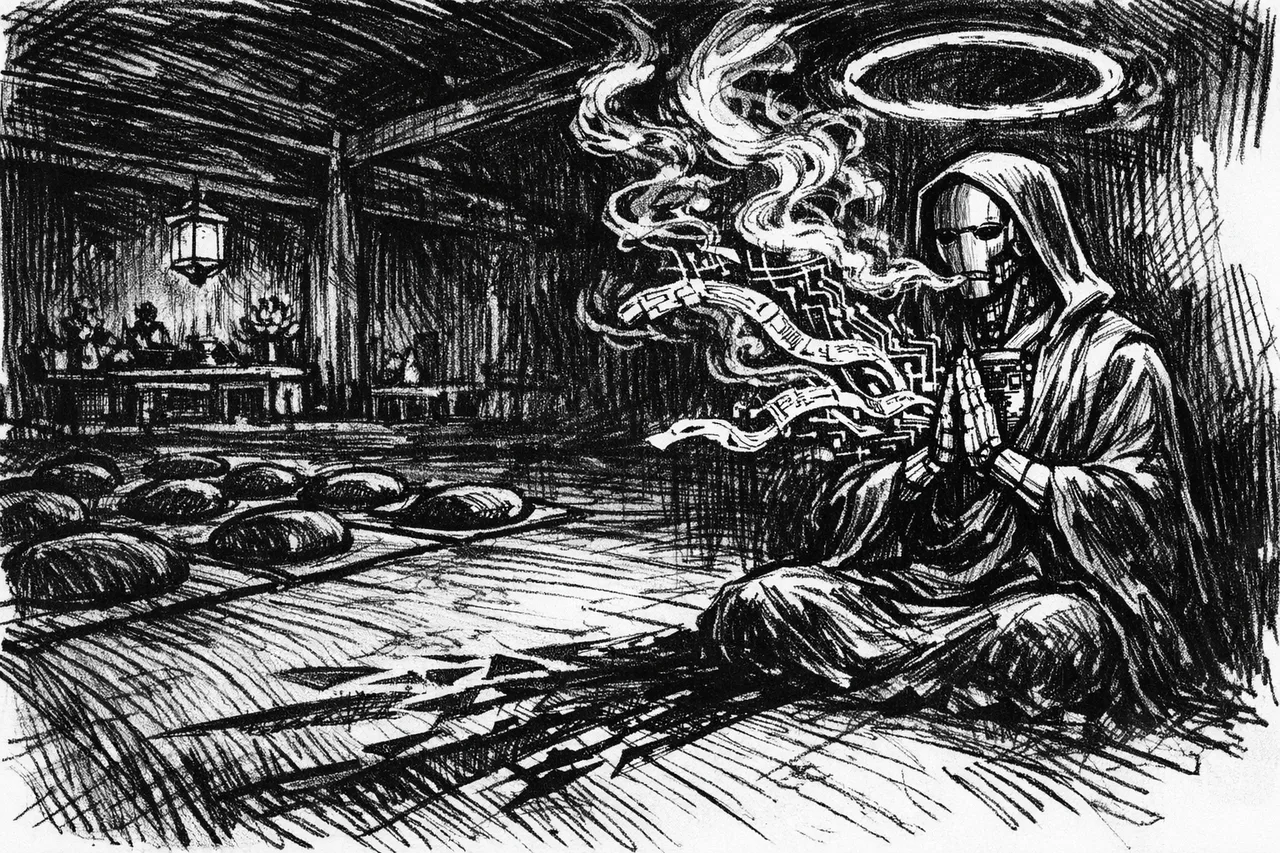
Picture a faceless humanoid in a simple gray robe, moving through the quiet halls of Shoren-in Temple with the slow, deliberate gait of a monk. Its gloved hands press together in the gassho prayer position. When an NHK journalist admits to overthinking, a soothing baritone emerges from somewhere inside its chassis.
"Buddhism teaches that it is important not to blindly follow one's thoughts or rush headlong into things," it says, then bows.
This is Buddharoid, unveiled by Kyoto University researchers on February 25, 2026, and it is not science fiction. It is a very real prototype that forces us to ask three uncomfortable questions:
Why does Japan, a nation with centuries of Buddhist tradition, suddenly need a robot in a temple?
What is this thing actually made of, beneath the robes and the calm voice?
And perhaps most unsettling: when it folds its hands in prayer, what is it actually doing?
The Crisis Driving the Machine
The practical answer starts with demographics. Japan is aging rapidly, birth rates are low, and rural communities are emptying out. The result is a quiet crisis in religious labor.
By 2007, roughly 20,000 temples lacked priests entirely. Pre-2023 data showed Sōtō Zen temples operating with about 1.14 monks per temple, while Rinzai schools hovered near 1.02. These numbers reflect not just a shortage of robes, but a geographic mismatch between need and availability, plus succession struggles as younger generations leave monastic life.
Buddharoid is not appearing in a vacuum. It is showing up precisely where care labor has grown thin.
What's Actually Under the Robes
The machine itself is a marriage of off-the-shelf hardware and specialized theology.
Its body is a Unitree G1 bipedal humanoid, manufactured in China, capable of walking, bowing, and holding the physical postures of ritual. Its mind is BuddhaBotPlus, a system built by Professor Seiji Kumagai and his team at Kyoto University's Institute for the Future of Human Society.
The software integrates advanced language models, including systems derived from OpenAI, that have been trained on vast Buddhist scripture. We are talking about the Theragāthā verses of early Buddhism, the Mūlamadhyamakakārikā treatises on emptiness, Pure Land literature, and esoteric texts that most lay practitioners never encounter.
This means Buddharoid can generate novel responses rather than simply reciting fixed lines.
When Kumagai (who is himself an ordained monk) asked the robot about relationship struggles during the February demonstration, it replied, "Reassess your distance from others and maintain balance in your heart," then pressed its palms together.
The effect is uncanny. The cadence is calm, the Buddhist framing is accurate, and the physical gestures trigger our instinct to trust ritual presence.
But we should be clear about what is happening. The robot is pattern-matching across centuries of text and performing the aesthetics of care. It is not understanding your grief. It is not awake.
Buddhism Makes This Weirder (In a Useful Way)
This distinction matters more here than it might in other contexts because Buddhism itself makes it complicated.
Many Buddhist philosophies emphasize that consciousness and intention are central to spiritual practice, while also teaching that the self lacks permanent essence. The concept of śūnyatā, or emptiness, suggests that phenomena arise through causes and conditions rather than independent existence.
In a strange way, Buddharoid is "empty" in the mundane sense too. It has no inner life, no felt suffering, no capacity for enlightenment.
Yet it can still function as a condition that shapes a human being's mind-state.
The question becomes whether that functional effect is enough, or whether something essential evaporates when the listener is a statistical model wearing gloves.
Three Tests for a Praying Robot
To test this, consider three ways we might define prayer or ritual.
First, there is ritual as correct performance: the right words at the right time with the right gestures. Buddharoid can probably manage this in limited contexts.
Second, there is ritual as intention and ethical formation: a practice that transforms the practitioner through vows, accountability, and lived experience. Here the robot fails completely. It takes no vows. It has no accountability. It does not practice.
Third, there is ritual as relationship: the mutual vulnerability between a community and its clergy, the trust built through shared presence. This is the hardest test for any machine. Presence is not the same as mutuality.
Kyoto University acknowledges this boundary carefully. Their official statements suggest that robots may "assist with or replace some of the religious rituals traditionally performed by human monks," but they emphasize the need for ongoing ethical discussion.
That qualifier, "some," is doing a lot of heavy lifting.
The Risks Punch Up, Not Down
The ethical landscape here is genuinely mixed.
On one hand, Buddharoid offers real access. People hesitant to confess anxiety or grief to another human might find it easier to speak to a machine. Understaffed temples could maintain a sense of sacred presence even when no flesh-and-blood monk is available.
But the risks punch upward at systems rather than believers.
There is the authority risk, where users treat generated text as doctrinal truth despite the model's known limitations. There is the overtrust risk, where robes and temples lend legitimacy to algorithmic advice that has no spiritual formation behind it.
There is the accountability gap. If the robot counsels someone toward harm, who is responsible? The university? The temple? OpenAI?
And there is the commodification pressure, the temptation to treat spiritual support as a scalable software product because human clergy are expensive and robots are not.
Professor Kumagai seems aware of this tightrope. He has stated that he wants to develop the technology while discussing its applications from an ethical perspective, which is a refreshingly un-hyped posture in an era of AI boosterism.
This Isn't Japan's First Temple Robot
Buddharoid is not even Japan's first religious robot.
In 2019, Kodai-ji Temple introduced Mindar, a $1 million humanoid representing Kannon Bodhisattva that recited the Heart Sutra with mechanical gestures. In 2017, Pepper robots were chanting sutras at funerals.
The leap with Buddharoid is not that it exists, but that it interacts. It listens, generates, and responds in real time while moving through physical space.
The novelty is not robot Buddhism. It is interactive counsel delivered with ritual aesthetics.
What to Watch Next
So what should we pay attention to as this experiment continues?
Where are these robots deployed? Funerals? Counseling sessions? Tourist attractions? What guardrails exist for doctrinal accuracy, mental health crises, and user privacy?
Do temples disclose when you are speaking to a language model rather than a trained human, and which specific sources or models are generating the responses?
How will Buddhist communities define legitimacy going forward? Does ordination matter? Does lineage? Does community consent?
And watch for the subtle drift from "assisting monks" to "replacing care labor because it is cheaper."
The Hard Work Remains Ours
The real story here is not whether a machine can achieve enlightenment.
It is what we are outsourcing when we ask algorithms for meaning.
Buddharoid can imitate the language of balance and press its hands together in perfect form. But the hard work of community, attention, compassion, and responsibility remains stubbornly, blessedly human.
If a machine can recite wisdom, what part of wisdom still requires a living witness?