
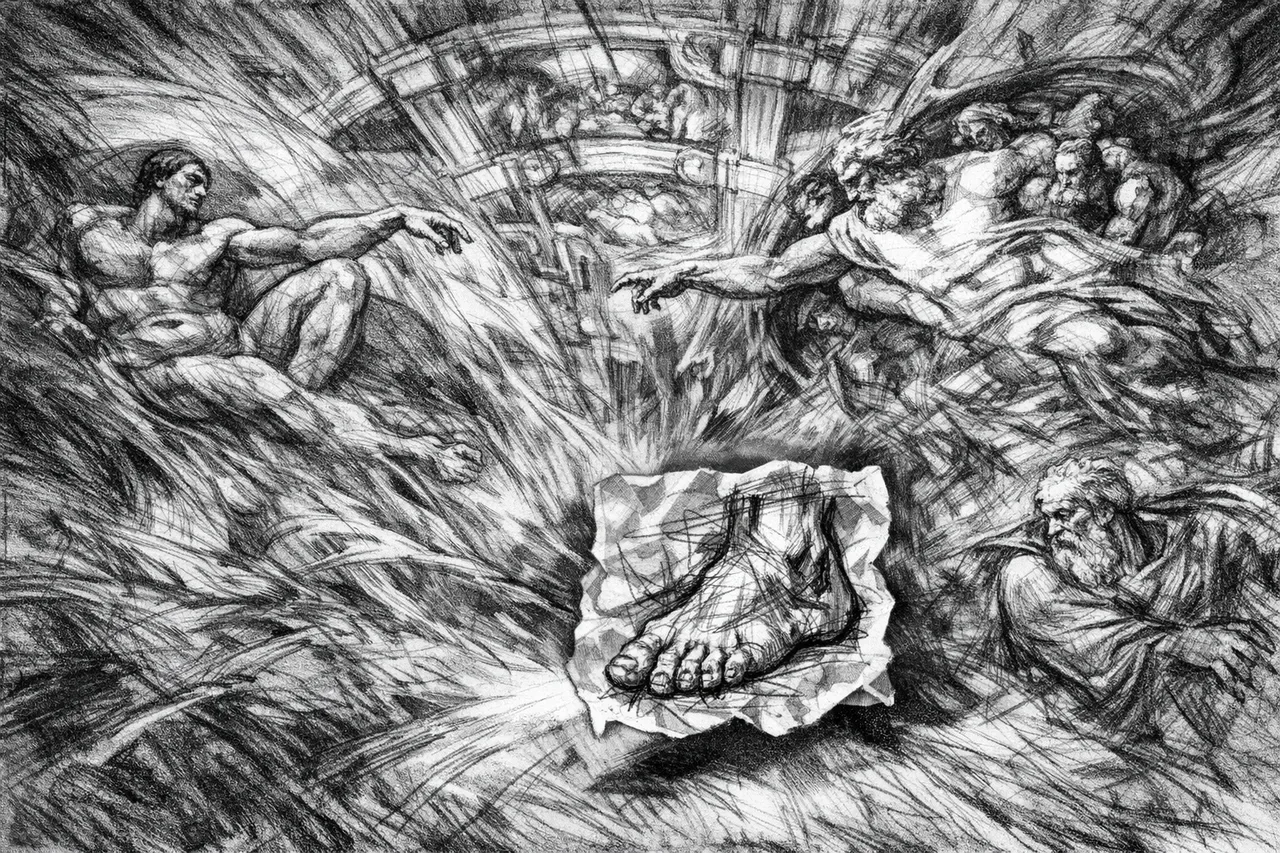
TLDR: A tiny Michelangelo foot sketch just sold for $27.2 million. The 13.5 cm red-chalk study—lost for 250 years and showing live corrections from a studio model—is the first Sistine Chapel preparatory drawing ever auctioned. It reveals the obsessive iterative process behind the masterpiece, proving mastery came from relentless revision, not divine inspiration.
A tiny red-chalk drawing of a right foot just sold for $27.2 million. It measures 13.5 by 11.5 centimeters—roughly the size of an index card. The same artist spent four years painting the Sistine Chapel ceiling, which covers more than 5,700 square feet of prophets, sibyls, and biblical drama.
Wait, what?
How does something you could slip into a pocket explain one of history's most monumental masterpieces? The answer isn't auction spectacle or mystical genius. It's process. This scrap of paper reveals the gritty reality behind Michelangelo's work: live-model anatomy, real-time corrections, relentless revision, and a creative method so secretive he tried to destroy the evidence.
The Object, In Plain English
This red-chalk study prepared the right foot of the Libyan Sibyl, a monumental prophetess painted on the Sistine Chapel ceiling around 1511–12. Of roughly 600 Michelangelo drawings that survived from thousands he created, only about 50 relate to the Sistine project. Of those, only 10 remain in private hands. This is the first Sistine preparatory study ever to reach auction.
But forget the rarity statistics. Stand in front of this drawing and you see something more immediate: the pressure points where the Sibyl's toes grip the ground. Faint lines at the heel, then bolder strokes where Michelangelo changed his mind mid-sketch. Red chalk marks that feel urgent, like someone solving a physics problem in real time.
How a Forgotten Sketch Resurfaced
The drawing spent the last 250 years with a West Coast family, unknown to scholars. No catalog listed it. No expert had examined it. Then the owners submitted a photo to Christie's free online estimate service, likely expecting routine feedback.
Giada Damen, a specialist in Old Master drawings, received the image and paused. She spent six months investigating, comparing it to a related Michelangelo sheet at the Metropolitan Museum of Art. That Met drawing contains studies for the same Libyan Sibyl: her back, head, left foot, and hand.
Infrared reflectography revealed a black-chalk study of a bent leg hidden on the back of the new drawing. The paper edges matched. A 16th-century brown-ink inscription, "Michelangelo Bona Roti," appeared on both sheets. One day Damen placed the two drawings side by side at the Met. "I was so excited," she recalled. "It was clear that the two studies were by the same hand, done in the same moment."
That is how a foot sketch found its way back into history.
Why a Foot Matters
The Libyan Sibyl poses a technical challenge. She is painted three times life-size, perched on the east end of the Sistine ceiling. She twists while stepping down from her throne, balancing on one foot while holding an enormous open book of prophecy. Her pose defies gravity. Get the physics wrong and the illusion collapses.
This foot study shows Michelangelo solving the problem on paper. You can see him calculating how the toes distribute weight, how the heel stabilizes, how the arch creates balance. The pentimenti at the heel are not mistakes—they are live revisions. First, a delicate outline. Then a firmer stroke, adjusting the angle for more tension. He was thinking on paper.
The medium matters too. Red chalk is harder and sharper than black chalk, ideal for precise flesh studies but nearly impossible to erase. Every line committed him further. Even Michelangelo had to workshop the heel.
The Live-Model Reality Behind Divine Bodies
These red-chalk studies came from live models, typically young male assistants in Michelangelo's studio. The Libyan Sibyl is female and clothed in the fresco, but her twisting pose, musculature, and bare feet were all mapped from a real person standing in the workshop.
The Met sheet shows the same study session from other angles: the model's back, bent arms, weight shifting through the left foot. The newly discovered drawing supplies the missing right foot. Why obsess over feet barely visible from the chapel floor? Because Michelangelo understood that convincing bodies start from the ground up. He was not channeling divine inspiration. He was looking, measuring, and adapting what he saw.
This is observation elevated to art, not magic.
Deadlines, Power, and a Relentless Work Ethic
Pope Julius II commissioned the ceiling in 1508, despite Michelangelo's protests that he was a sculptor, not a painter. For four years, Michelangelo worked in cramped scaffolding conditions, painting one bay at a time while navigating the Pope's volatile temper and rival artists attempting sabotage.
He hated exposing his process. That is why he burned most of his preparatory drawings, hoping to conceal the labor behind the final result. The few that survived likely escaped because they were given away or lost before he could destroy them.
This foot sketch is an accidental window into that secretive method. The myth of effortless genius gets packaged and sold, but the drawing shows uncertainty, iteration, and relentless problem-solving. That honesty makes it powerful.
The Auction vs. the Revelation
The final bid hit $27.2 million on February 5, 2026, at Christie's New York, far exceeding the $1.5 to $2 million estimate. The price is loud. The quiet revelation is louder.
This scrap of red chalk is a receipt for labor. It records micro-decisions that make a macro-masterpiece believable. The auction spectacle values rarity, but the drawing itself points elsewhere. It says mastery is not innate—it is practiced. It says the way to paint prophets and sibyls is to start with a foot pressing against the ground.
What the Tiny Foot Changes About Genius
The foot sketch offers three reminders. First, small studies build grand visions. Second, revision is the secret ingredient. Third, art history becomes more inspiring when we see the human effort underneath.
As art historian Carmen Bambach notes, Michelangelo's drawings afford the most direct glimpse over the shoulders of genius, melting away centuries to reveal an intimate creative process. That glimpse shows us someone solving problems with chalk, not conjuring miracles.
Five hundred years later, his tiny foot study still touches the ground. So can we.