
TLDR: Heavy rain in Death Valley didn't deliver new seeds for the 2026 superbloom—it washed away the protective coatings that had kept dormant seeds locked in soil for decades. This once-per-decade spectacle reveals the desert as a living vault, not a dead landscape.
Right now, the hottest, driest place in North America looks like someone knocked over a paint box. Death Valley National Park is experiencing its best superbloom since 2016, with low-elevation hillsides blanketed in yellow Desert Gold, sweeping purple Phacelia, and the otherworldly white blooms locals call Gravel Ghost. The National Park Service confirmed on March 13, 2026 that the show will likely continue through mid-to-late March at lower elevations, with higher elevations blooming through June.
It is genuinely beautiful. And the real story behind it is stranger than "rain makes flowers."
The flowers were not created by this winter's rain. They were already there, hidden in the soil, waiting for something very specific to wash away.
The Real Answer
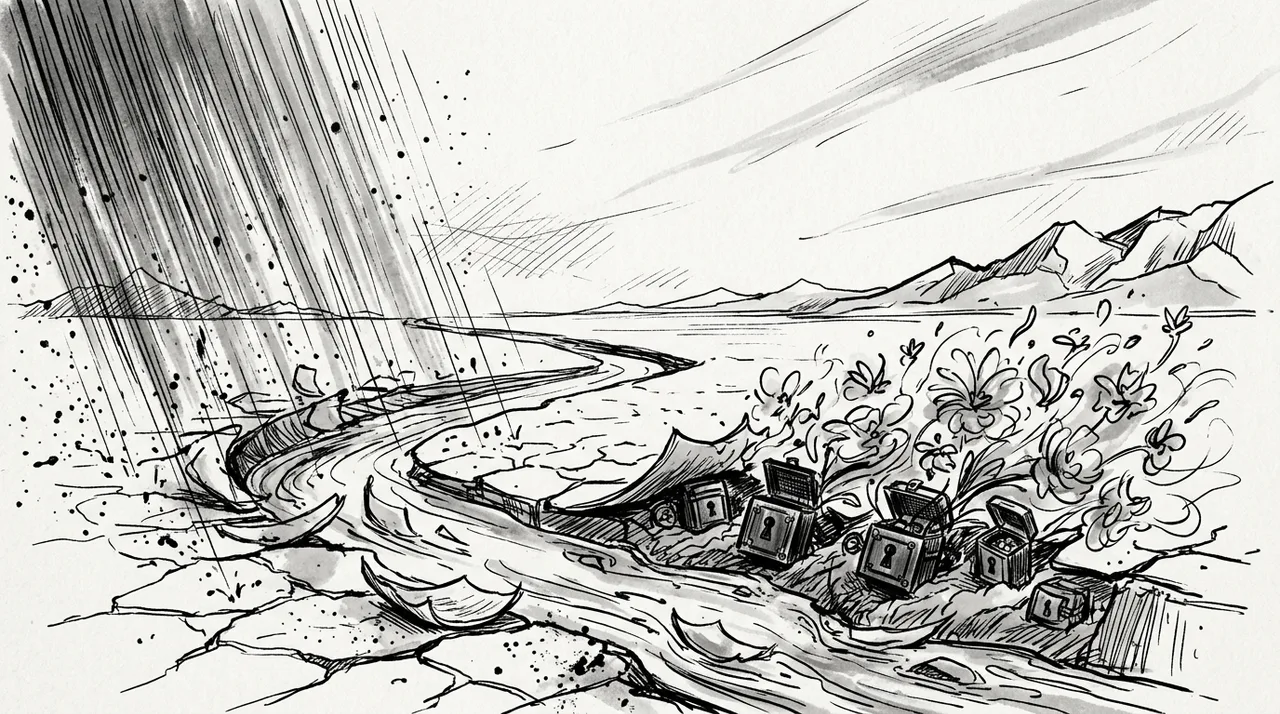
Here is the "wait, what?" moment. When heavy rain falls on Death Valley, it does not deliver new seeds. It removes the locks on old ones.
Desert wildflowers are annuals, also called ephemerals. Rather than fight the brutal heat year-round, they survive as seeds buried in a soil seed bank, lying dormant for years or even decades. Each seed carries a protective chemical or waxy coating that prevents it from sprouting during brief, unreliable rains. Think of it as a built-in lie detector for rainfall. A light drizzle cannot strip that coating. A soaking downpour of at least half an inch can.
That initial heavy rain literally washes the germination inhibitors off the seeds. Once the coating dissolves, the seed absorbs water, splits open, and begins a frantic race to bloom, pollinate, and produce the next generation before the desert heat returns.
The rain did not wash away the seeds. It washed away the barrier keeping them asleep.
Why 2026 Worked
Between November 2025 and January 2026, Death Valley received roughly 2.5 inches of rain. For context, the park's typical annual average is about 2 inches. An entire year's worth of moisture arrived in concentrated bursts driven by El Niño patterns.
But volume alone does not make a superbloom. The rain must soak deeply rather than flash-flood away. It needs to be followed by well-spaced moisture through winter and spring. Sprouted seeds can look like nothing is happening above ground for weeks while they build root systems below the surface. Then spring warmth triggers the visible burst. And at every stage, harsh drying winds are the enemy. A single windstorm without follow-up rain can kill delicate sprouts before they ever flower.
In 2026, the chain held. Seeds unlocked, roots took hold, warmth arrived gently, and the winds cooperated. The result is color across terrain that is usually sand, gravel, and rock.
Why Superblooms Stay Rare
Death Valley does not do this every few years. True superblooms, described by the Park Service as conditions where flowers appear as swaths of color rather than isolated plants, average roughly once per decade. The last three were 1998, 2005, and 2016.
That rarity is worth holding onto. During the 2016 superbloom, more than 209,000 people visited the park, causing traffic jams and damage from trampling. The desert crust and seed bank beneath visitors' feet can take years to recover. The superbloom is the exception, not the rule. Most years, Death Valley looks like Death Valley, and that is how the ecosystem is supposed to function.
Meet the Flowers Making the Show
If you visit, you are not looking at generic wildflowers. You are looking at specific plants that have evolved for this exact sprint.
Desert Gold dominates. This yellow, sunflower-like annual can blanket entire hillsides at low elevations, creating the rolling golden fields visible near the Furnace Creek Visitor Center. It is the workhorse of the bloom.
Gravel Ghost is the magic trick. Its thin gray stem vanishes against the desert floor, making the white flower appear to float in midair. Drive too fast and you will miss it. See it once and you will not forget it.
Desert Five-Spot offers pink petals with dark red spots. Phacelia adds lavender and purple tones across hillsides, though note: some phacelia species can irritate skin, so admire without touching. Brown-Eyed Primrose and Sand Verbena fill in the remaining palette.
A Temporary Pulse of Abundance
This bloom is not just a spectacle. It is an ecological event. By flowering all at once in a single concentrated burst, these plants create a brief, intense buffet for pollinators that rarely visit Death Valley otherwise: bees, butterflies, moths, and hummingbirds.
The flowers are built for speed. They grow, bloom, and set seed in weeks because they must complete their entire life cycle before the heat takes over. When the show ends, seeds scatter, the soil reclaims them, and the lock clicks back into place. The desert does not die. It goes back to waiting.
How to See It Without Loving It to Death
As of mid-March 2026, the best viewing areas are Badwater Road between Highway 190 and Sidewinder Canyon, Highway 190 between Stovepipe Wells and Furnace Creek, and the Beatty Cutoff. The Ashford Mill area is already past peak.
Expect crowds. Park completely off the travel lane when pulling over and check for deep sand before stepping out. Stay on roads and designated pullouts. Do not pick flowers, drive off-road, or bring drones, which are prohibited in the park. Every plant you step on represents seeds for the next potential bloom. A sudden heat spike or harsh winds could end the low-elevation show quickly, so check the NPS Death Valley wildflowers page for current conditions before you go.
What the Bloom Does Not Guarantee
It is tempting to read large climate narratives into a superbloom. There are no verified projections suggesting these events will become more frequent as the climate warms. They still depend on highly specific combinations of rain timing, volume, temperature, and wind. Warming temperatures, prolonged drought, and erratic heat spikes can work against those conditions just as easily as a wet El Niño year can briefly enable them.
The superbloom is a lottery. Not a trend.
What Was Here All Along
The next time you see a photograph of Death Valley carpeted in gold and purple, remember what actually happened. The rain did not conjure life from nothing. It removed an obstacle that was keeping life in check.
That desert floor, the one that looks empty for years at a stretch, is a vault. It stores possibility in the form of dormant seeds, each coated in a patient chemical lock, each one waiting for the right rain at the right time with the right temperature and the right wind.
The miracle here is not that Death Valley suddenly became alive. It is that it was alive the whole time, quietly, invisibly, waiting.