
TLDR: What killed 40 people in under two minutes wasn't the New Year's pyrotechnics—it was the foam ceiling they ignited. The same lethal combination has killed hundreds before, exposing how checkbox enforcement turns known fire hazards into death sentences.
You've held a sparkler. That fizzy little firework that makes birthday cakes glow. Harmless fun, right? Now picture this: a ski resort bar at 1:30 a.m. on New Year's Day. Champagne bottles topped with fountain candles. Staff parading them through the crowd. Someone hoists a bottle toward the ceiling. Sparks shower upward.
Two minutes later, 40 people are dead and 119 are injured—burns so severe that DNA identification takes three days.
Wait, what?
What Actually Happened
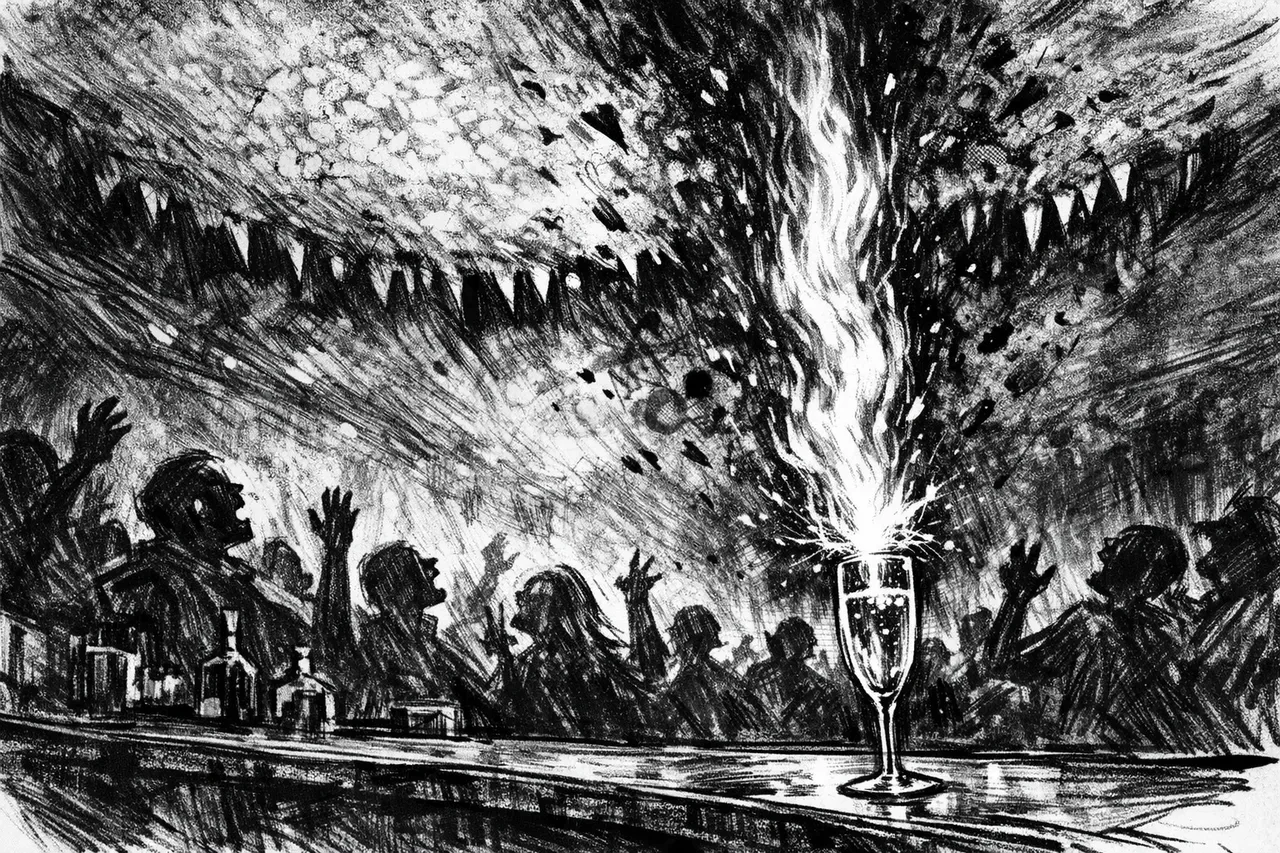
Le Constellation bar in Crans-Montana, Switzerland, was hosting its annual New Year's party. The two-level venue had been a local institution for 40 years, holding 300 people plus a terrace. Around 1:30 a.m., waiters carried champagne bottles topped with "fountain candles"—not tiny birthday sparklers, but pyrotechnic devices shooting foot-long flames—through the basement bar.
When staff held them too close to the low ceiling, they ignited the soundproofing foam overhead.
The fire spread with brutal speed. Witnesses described an "immense fire blast" within ten seconds. Police arrived two minutes after the first alarm. By then, the basement had become an inferno.
The victims included a 14-year-old Swiss girl and nine other minors, along with nationals from Italy, Romania, Turkey, and France. All 40 were identified by January 4 through DNA analysis. The burns were that extensive. A memorial service followed the same day.
The bar's owners, French couple Jacques and Jessica Moretti, now face criminal investigation for suspected negligent homicide.
Sparklers Aren't Harmless Theater
These "fountain candles" generate significant heat and shoot a directed spray of hot particles upward. That's their job. In a crowded basement with a low ceiling, raising them overhead creates a blowtorch inches from flammable material.
Fire safety experts note these devices burn hotter and longer than handheld sparklers. The physics is simple: heat rises, sparks rise, and when staff routinely perch on shoulders to parade bottles through packed rooms, you're engineering a scenario where open flame meets ceiling. Regularly.
One young survivor told reporters about visiting the night before: "There was a table next to us that had the same show." This was standard entertainment.
Your Ceiling Is Fuel
That ceiling wasn't wood or plaster. Fire safety experts examining photos and videos identified "egg box foam"—acoustic panels that look like textured soundproofing. The kind you'd see in a recording studio.
But untreated polyurethane foam isn't soundproofing. It's fuel.
Dr. Peter Wilkinson from Loughborough University explains: "Once ignited, polyurethane acoustic foam can exhibit rapid flame spread across its high-surface-area profile and produce dense, toxic smoke." The foam melts, drips, and creates more surface area for flames to consume. One expert calls it "plastic petrol."
The foam at Le Constellation appears to have been uncovered, possibly loose in places. Footage from a regular patron shows foam hanging down several inches. In a low-ceiling basement, your ceiling becomes a textured wick. Add sparks, and you've built a fire delivery system.
The Two-Minute Death Sentence: Flashover
Within under two minutes, the fire transformed. Firefighters call it flashover—the moment a room stops containing a fire and becomes fire.
Hot gases pool at the ceiling, preheating everything below. At around 500 to 1000 degrees Fahrenheit, every combustible surface—tables, chairs, clothing—ignites simultaneously. Steve Kerber from UL's Fire Safety Research Institute puts it plainly: "All the wood, all the seats, all of the decorations and everything else in the room would be heated to the ignition temperature."
Survival after flashover is, as ETH Zurich fire expert Michael Klippel says, "very unlikely." Even firefighters in full gear struggle. For partygoers in a basement with one narrow stairway, it becomes mathematically impossible.
The smoke alone becomes lethal, dropping visibility to zero while toxic gases fill the space. People don't just burn. They're overcome before they can find exits.
What the Videos Show
Watch the footage and you see the pattern. Orange glow appears. Someone tries to pat it out with clothing. Ten seconds later, black smoke billows. Then the blast.
This isn't a slow-moving disaster where people have time to process what's happening. The human brain needs seconds to realize "this is dangerous" while physics moves at light speed.
The layout tells its own story. Basement venue. Narrow stairs. One door. When flashover hits, everyone funnels to the same exit. Bystanders who broke down doors described people "burning from head to foot, no clothes any more."
That's what flashover does. That's not a fire you escape by running faster.
When "Strict Rules" Live Only on Paper
Switzerland has stringent fire codes. Public venues over 200 capacity need multiple open exits, smoke ventilation, non-flammable furnishings, and special permits for indoor pyrotechnics. Annual inspections are required.
So what happened?
The investigation is asking the uncomfortable questions. Was indoor pyrotechnics permitted? Was the foam fire-retardant or covered as required? Were inspections actually annual?
The bar's owner told one newspaper it was inspected "three times in 10 years" and "everything was done according to standards." Local regulations require annual checks. That's a gap.
Mayor Nicolas Féraud said inspections occurred annually or bi-annually but declined to discuss details. The Valais security chief noted that "something didn't work—maybe the material, maybe the organization."
When regulations exist but enforcement becomes procedural checkbox-ticking rather than substantive safety verification, gaps emerge between paper safety and real safety.
This Fire Killed People 23 Years Ago. And 13 Years Ago. And Now.
In 2003, The Station nightclub fire in Rhode Island killed 100 when pyrotechnics ignited foam insulation. In 2013, the Kiss nightclub fire in Brazil killed over 200 under similar circumstances.
The pattern isn't coincidence. It's systems failing the same way, repeatedly.
Cultural incentives push toward spectacle. Bottle service with sparklers is theater. It signals "celebration." It drives sales. Fire behavior doesn't care about your Instagram moment.
The uncomfortable truth: we've known this combination kills people for decades, yet the practice persists because the risk feels abstract until it isn't.
This Wasn't About Stupid People Making Bad Choices
Forty people died celebrating a new year. They were teenagers, tourists, locals. The youngest was 14. Their families waited days for DNA confirmation because the injuries were that devastating.
This isn't a story about stupidity. Normal people were caught by abnormal physics in a system that allowed a known risk to persist. The bar was popular precisely because it was affordable and didn't charge entry fees. It served locals and young people. The victims weren't seeking danger. They were seeking celebration.
What This Means for You
You don't need to become a fire inspector. But you can adopt a "look up" mentality:
If you're in a crowded venue and staff are carrying open flames near a low ceiling, that's physics waiting to happen. Leave, or don't enter.
Notice exposed foam or textile panels on ceilings. Good soundproofing shouldn't look like egg crates. If you can see texture, it's potentially exposed foam.
Thick, dark smoke pooling low means flashover is imminent. Don't film it. Go.
Basements with one exit are funnels, not escape routes. Know where exits are before you need them.
Celebrations should scale with safety, not with hype. The science isn't hidden. It's just overlooked until it's too late.
The Real Underheadline
The sparkler was the spark. It wasn't the cause.
The cause was a system that allowed a ceiling to remain a fuel source, a business model that normalized indoor pyro, and regulations that looked good on paper but missed the reality of a basement packed with young people.
The "wait, what?" moment isn't that a sparkler could start a fire. It's that we keep building rooms where a sparkler becomes a death sentence. We keep treating celebrations as products to engineer for maximum spectacle while treating safety as an invisible afterthought.
Curiosity about what's overhead isn't paranoia. It's the kind of skepticism that keeps celebration from turning into mourning. It's noticing that the ceiling matters before it's over your head.