
TLDR: A photographer discovered 20,000 dinosaur footprints marching up a vertical
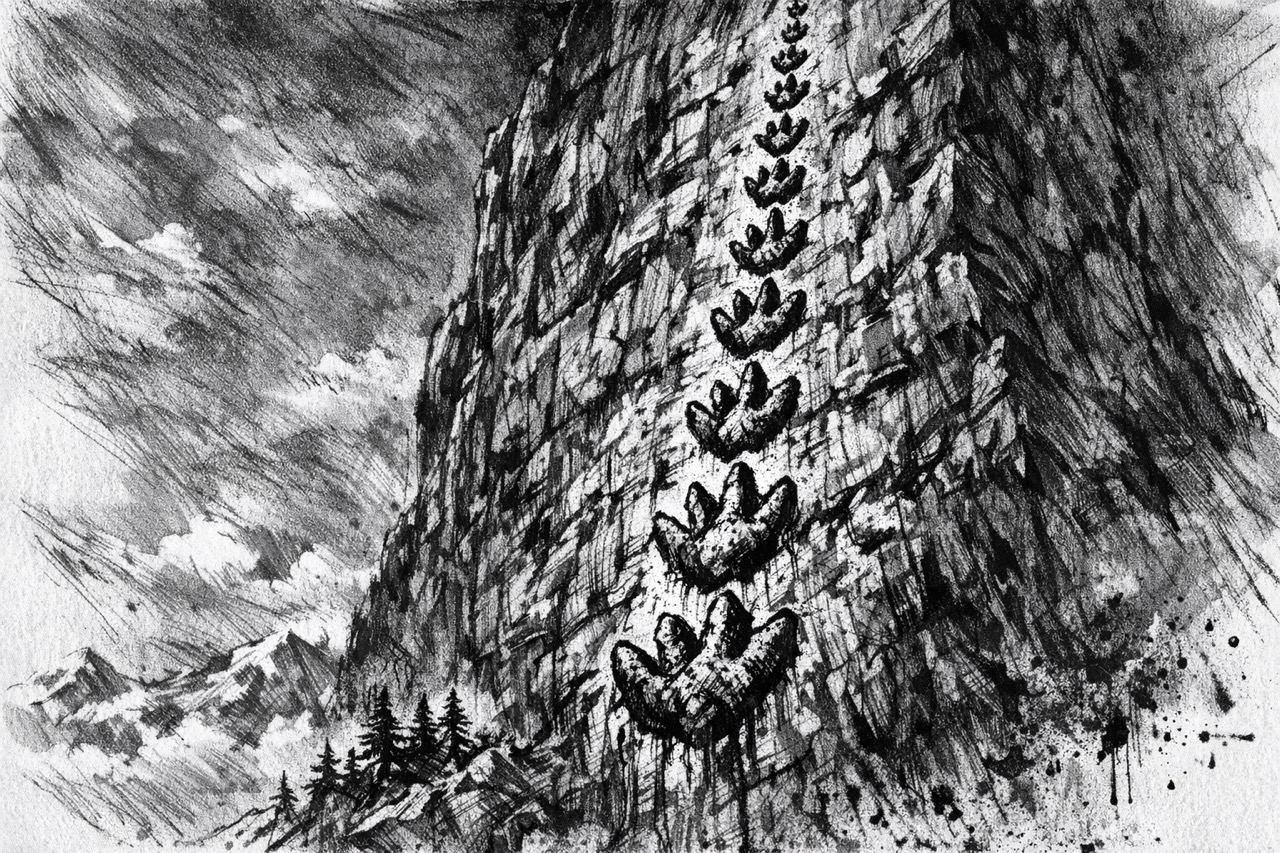
Picture a nearly vertical cliff face in the Italian Alps, 2,000 meters above sea level. Your neck cranes back. Thousands of dinosaur footprints march upward across the rock as if gravity took a holiday 210 million years ago.
Wait, what?
This isn't evolutionary gymnastics. It's what happens when Earth rewrites geography—transforming a flat, muddy coastal plain where dinosaurs commuted into a near-vertical wall in Stelvio National Park. The footprints didn't climb. The planet tilted their world sideways.
A Photographer Spots Something Strange
Last September, nature photographer Elio Della Ferrera was tracking deer and vultures through the remote Valle di Fraele between Bormio and Livigno when his binoculars caught something odd: regular depressions scoring a vertical dolomite face. He scrambled up for a closer look.
"The huge surprise wasn't discovering the footprints," Della Ferrera recalled, "but discovering such a huge quantity."
That call to paleontologist Cristiano Dal Sasso at Milan’s Natural History Museum sparked a revelation announced December 16, 2025: possibly 20,000 tracks spanning five kilometers across seven ridges, making it one of Europe's largest and richest Triassic tracksites. But no peer-reviewed study exists yet—this is early-stage science, inaccessible terrain, and decades of mapping ahead.
The real story? How flat became vertical.
From Tidal Flats to Cliff Faces: A Geological Plot Twist
The Original Crime Scene
Rewind 210 million years. No Alps. Just a warm tropical coastline bordering the ancient Tethys Ocean, where wide tidal flats of soft calcareous mud recorded every footfall in exquisite detail: long heels, four-toed prints with claw marks, occasional hand impressions.
"The footprints were impressed when sediments were still soft," explains ichnologist Fabio Massimo Petti of Trento’s MUSE museum. "The plasticity of those fine muds preserved remarkable anatomical details—toes, even claws."
The mud hardened into dolomite. Layers stacked up like pages in a book, each recording a different moment.
When Continents Collide
Then came the plot twist: Alpine orogeny. Over 65 million years, the African and Eurasian plates crashed together, building mountains and tilting entire sedimentary blocks from horizontal toward vertical. Geologist Fabrizio Berra calls the stacked strata "pages of a stone book"—except this book got stood on edge.
The tracks sit north of the Insubric Line, a major tectonic boundary. This makes them the first prosauropod footprints found in this Alpine domain—giving geologists rare data on where ancient coastlines met plate boundaries.
Glacial erosion during ice ages then stripped away overlying rock, exposing those vertical pages as cliff faces. The footprints stayed put. The ground beneath them rotated 90 degrees and climbed 2,000 meters.
What the Vertical Herd Reveals
The Trackmakers
Most prints measure 40 centimeters wide—elongated bipedal marks with four toes ending in claws. Scientists attribute them to prosauropods, early herbivorous relatives of giant sauropods. Think long-necked walkers up to 10 meters long, weighing four tons, like the better-known Plateosaurus. Some tracks might belong to predatory dinosaurs or archosaurs, but that awaits detailed analysis.
Synchronized Movement, Not Random Wandering
Here's where it gets compelling. The tracks form parallel rows extending hundreds of meters—multiple individuals moving in the same direction simultaneously. "Herds moving in synchronized fashion," Dal Sasso notes.
You're not seeing scattered prints. You're seeing a migration corridor, a repeated route between resources. Circular groupings suggest defensive clustering. Resting marks show where the herd paused. This is social structure in action, 210 million years before the first human thought about cooperation.
The pattern resembles modern wildebeest corridors or elephant routes to water—not the species, but the logic of group travel across landscapes.
Slow Commute, Not High-Speed Chase
Trackway geometry suggests deliberate travel, not sprinting. Detailed stride measurements aren't released yet, but the steady parallel movement over distance tells the story: think seasonal migration, not panic flight.
Why This Matters Beyond "Biggest Ever"
Multiple stacked surfaces mean repeated snapshots through time—potentially capturing seasonal shifts, changing herd compositions, environmental fluctuations. Most tracksites preserve one afternoon. This preserves a recurring story.
The Late Triassic is a critical window: early dinosaur footprints diversifying, ecosystems shifting, and Europe's fossil record patchy. Finding thousands of tracks in sequence, in a region with none previously documented, fills a missing chapter in vertebrate evolution.
Scientists will use drones and remote sensing to systematically map the steep, inaccessible terrain—creating 3D models to measure, compare, and interpret. It's slow work. No instant revelations, just careful documentation stretching years ahead.
Earth, the Ultimate Renovator
The real marvel isn't vertical-walking dinosaurs. It's that an ordinary Triassic afternoon—herbivores slogging across tidal flats—got frozen, rotated 90 degrees, and hoisted skyward.
Nature doesn't just preserve history. It rearranges it, then drops it in a photographer's binoculars 210 million years later.
They weren't defying gravity. The planet was just showing off.
Dive deeper into Earth's hidden stories—share your "wait, what?" moments in the comments!