
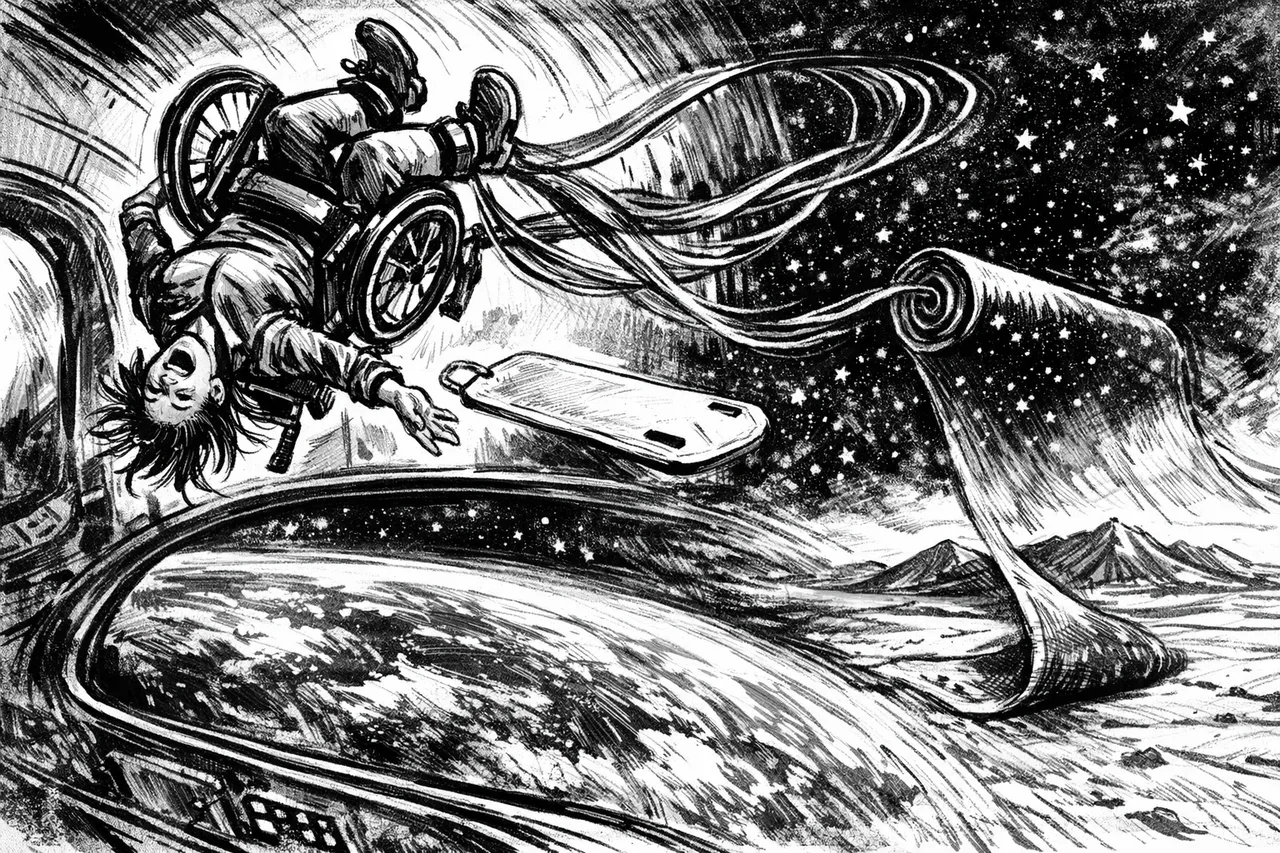
When Michaela Benthaus felt gravity release its grip 100 kilometers above Texas, she did what any first-time astronaut might do: she tried to flip upside down.
For three to four minutes inside Blue Origin's capsule, she floated weightless with five crewmates, watching Earth curve below through windows designed for exactly this view. The headlines wrote themselves: first wheelchair user in space. Historic milestone. Barrier broken.
But the real story isn't in the "first." It's in the surprisingly ordinary engineering choices and hidden bodily challenges that made those minutes possible.
What did we actually need to change about spaceflight to make this happen? Less than you'd think. And more than the press releases let on.
The Flight That Almost Looked Routine
On December 20, 2025, Blue Origin's NS-37 mission launched from Launch Site One in West Texas. The suborbital flight lasted about 11 minutes, sent six private citizens past the 100-kilometer Kármán line, and exposed them to forces up to five times Earth's gravity before delivering three to four minutes of weightlessness.
Benthaus, a German aerospace and mechatronics engineer, had been using a wheelchair since a 2018 mountain biking accident damaged her spinal cord at the T12-L1 level. She spent years preparing through AstroAccess parabolic flights, centrifuge training, and commanding a wheelchair-accessible analog mission at Poland's Lunares Research Station.
Her crew included Hans Koenigsmann, a former SpaceX executive who served as her designated emergency assistant. That detail matters more than most launch coverage suggested.
Your Legs Don't Float the Same
The physiological reality of spaceflight changes when your nervous system doesn't regulate blood pressure the way most bodies do.
Spinal cord injuries above the T6 level often compromise the autonomic system's ability to constrict blood vessels effectively. Under the five g-forces of launch and re-entry, blood pools in everyone's legs. Typical bodies compensate by tightening vessels and ramping up heart rate. In someone with autonomic dysfunction, that compensation can fail.
The result? Sudden blood pressure drops. Fainting risk. Post-flight dizziness severe enough to require medical intervention.
Space medicine specialists note this mirrors conditions in elderly patients or those recovering from prolonged bedrest, populations where orthostatic intolerance is already a documented concern. The short duration of Benthaus's flight helped mitigate this risk. It didn't erase it.
The Zero-G Paradox
Weightlessness offered something rarer than spaceflight itself: freedom of movement many wheelchair users rarely experience on Earth.
But microgravity also accelerates muscle atrophy by up to 16 percent and bone loss at one to two percent per month. Those rates compound the existing disuse atrophy common after spinal cord injury. Benthaus's 11-minute suborbital hop was too brief to trigger measurable decline, but the principle looms over anyone dreaming of longer missions.
As one microgravity physiology researcher framed it: "What happens in four minutes is an appetizer. What happens in four weeks is the meal."
The flight proved feasibility for brief excursions. It didn't prove that disability barriers vanish for extended stays on the International Space Station or Mars.
The Logistics Nobody Puts in Mission Patches
How do you keep legs from drifting into control panels during weightlessness? Blue Origin added simple leg-securing straps to the standard seat.
How do you transfer from wheelchair to capsule seat in a cramped hatchway? A patient transfer board, essentially a sturdy sliding bench, let Benthaus scoot from hatch to seat with Koenigsmann's assistance.
After touchdown, the recovery team unrolled a carpet across the West Texas desert sand to give her immediate wheelchair access. No sand. No struggle. Just a direct path back to mobility.
These weren't structural overhauls. They were interface solutions, the kind of quiet adaptations that accessibility demands and engineering often overlooks.
The Innovation Was Operational, Not Mechanical
Blue Origin's autonomous capsule meant Benthaus didn't need to pilot or perform complex manual tasks during flight. The launch tower's existing elevator already accommodated wheelchair access. No retrofit required.
The company assigned Koenigsmann as her designated helper, not because she couldn't participate, but because crew resource management demands explicit contingency plans. In an emergency evacuation, he would assist her exit.
This isn't special treatment. It's the same redundancy that assigns any crew member specific safety responsibilities. The difference here? The plan was visible instead of assumed.
Blue Origin engineer Jake Mills, who trained the crew, put it simply: the autonomous New Shepard capsule was "designed with accessibility in mind, making it more accessible to a wider range of people than traditional spaceflight."
Translation: when you stop requiring every passenger to be a test pilot, you open the airlock wider.
What This Actually Means for "Space for Everyone"
The European Space Agency's Parastronaut Feasibility Project has reached similar conclusions, reporting "no showstoppers" for including astronauts with disabilities on ISS missions. AstroAccess has been testing microgravity mobility tools, from Velcro anchors to custom restraints, on parabolic flights since 2021.
These incremental steps build a foundation. They don't solve the deeper questions of cost, medical qualification standards, or long-duration health monitoring.
The Hype Check
There's a temptation to frame Benthaus's flight as proof that space is now universally accessible.
Her seat reportedly cost upwards of $500,000, funded through a combination of private sponsorship and Blue Origin's selection process. The flight lasted minutes, not months. The adaptations were minor but specific: patient board, leg straps, carpet, buddy system.
Accessibility in space, like on Earth, lives in the details and the dollars, not just the inspiration.
Benthaus herself offered a grounded perspective in a CNN interview: "We're thinking more and more about long-duration space missions. Some of us want to go to Mars in the future. That's a very long journey. And yes, people can get a disability on the way. People can have a stroke or break their leg or get a spinal cord injury."
She wasn't just talking about inclusion. She was talking about incidental disability as a normal mission scenario.
The Real Milestone
The barrier wasn't that a wheelchair user went to space. The barrier was believing one could.
The engineering solution was a board, some straps, and a carpet. The operational solution was explicit planning instead of unstated assumptions. The physiological solution was choosing a flight profile short enough to minimize autonomic stress while long enough to deliver the experience.
None of this was revolutionary. All of it was necessary.
When Benthaus landed and greeted the recovery team, she was ecstatic. "It was the coolest experience," she said. She'd tried to turn upside down. She'd floated. She'd come home safely.
The real achievement isn't one person's flight. It's the proof that when we stop assuming who belongs in the capsule and start designing for the bodies that actually exist, the barriers shrink to engineering problems with engineering solutions.
If spacecraft were built for incidental disability as a normal mission scenario instead of an exception, what would change?
Maybe nothing dramatic. Maybe everything that matters.