
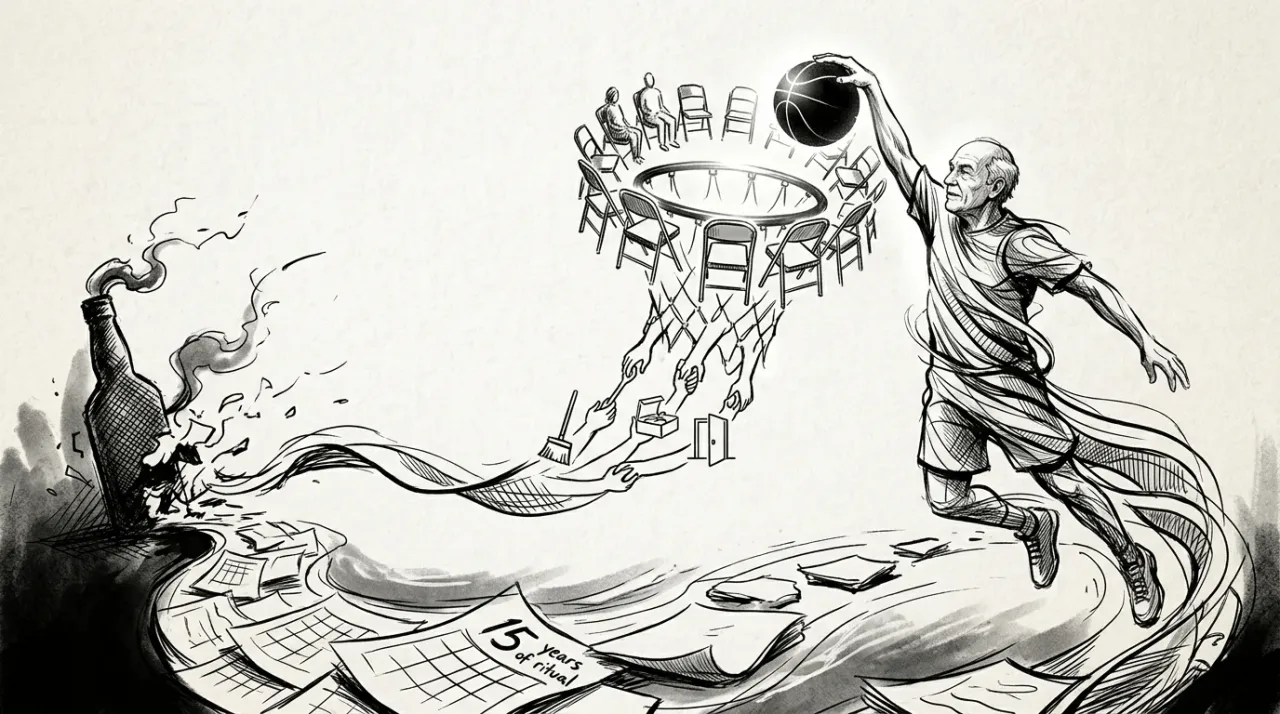
TLDR: NBA legend Marques Johnson's viral 70th-birthday dunk is a 15-year ritual, but the real lift isn't athletic—it's 24 years of daily recovery meetings and community service that rebuilt his life from "functional addict" to still rising.
A 70-year-old man rises off two feet and finishes with a one-handed slam. The ball goes through clean. The landing looks controlled. Scroll past it quickly on social media and you might mistake it for clever editing.
But the timestamp is real: February 23, 2026. The man is Marques Johnson, the former Milwaukee Bucks star who, at an age when most people are managing joint replacements, is still getting above the rim. His Instagram caption reads, "Still dunking at 70 years old!!!" with a prayer emoji.
Before we treat this like a viral party trick, it helps to know who Johnson is and what the clip leaves out. The dunk is not just a physical feat. It is a punchline, a discipline check, and a receipt for 24 years of daily maintenance that has nothing to do with basketball.
The Dunk and the "Last One"
Johnson turned 70 on February 8, but saved the dunk for a session with his son, Josiah, at a Los Angeles gym shortly after All-Star Weekend. He wore a Crenshaw High School baseball jersey, sang the school's spirit song, and dedicated the slam to the South LA institution that shaped him.
This was the 15th installment of a birthday tradition that started around 2011 as a joke, a playful nod to Blake Griffin's over-the-car dunk where Johnson jumped over two toy Matchbox cars instead. Every year he declares it his "final" dunk. Every year he finds another one. This time he timed the clip to promote The Crenshaw Chronicles, his new book about the high school's legacy.
The video went viral, but the algorithm only sees the elevation. It misses the foundation.
Yes, He Was Actually That Good
Johnson was UCLA's first John R. Wooden Award winner in 1976-77 after helping the Bruins win the 1975 NCAA title. The Bucks drafted him third overall in 1977. Over 11 NBA seasons he averaged 20.1 points, 7.0 rebounds, and 3.6 assists per game. Five-time All-Star. All-NBA First Team in 1979. Milwaukee retired his number 8 jersey in 2019.
Being six-foot-seven with elite athletic genes helps. But that does not explain why he is still capable of something most former players abandon by 40. The bigger surprise is that he rebuilt a life sturdy enough to keep doing it.
The Part the Highlight Reel Skips
Johnson does not hide the fact that his post-playing career included years as what he calls a "functional addict," someone who could perform on television and fulfill professional obligations while struggling with drugs and alcohol.
The turning point came in 2002, when he was 46. He attended a meeting to support an ex-girlfriend and met a man who had gotten sober at the exact same age. "OK, well, maybe it's not too late," Johnson thought.
That was 24 years ago. Today, he describes his status with precision: "I'm still in recovery. I'm never cured. My disease, I've been able to resist it one day at a time by going to meetings, by doing a bunch of other things that I do on a daily basis."
He calls the decision to change course the best he ever made. When he says he feels blessed to have his health and mental ability intact, he is comparing himself to a version of his life that did not survive.
This context shifts the dunk from "can you believe this old guy?" to "what does it take to keep showing up?"
What the Dunk Actually Represents
There is a temptation to treat aging like an enemy that can be defeated with enough willpower. Johnson's dunk is not that. It is a symbolic deadline he keeps setting for himself, a comedian's bit that doubles as a fitness check.
He does not play pickup basketball. He does not dunk in his free time. He saves it for once a year, which suggests a body preserved through restraint, not constant pounding. Other Hall of Famers like Julius Erving and Dominique Wilkins have dunked into their later years, so this is rare but not magic. It is the visible tip of an invisible structure.
The message is not that everyone should aim to dunk at 70. It is that consistency, maintained through unglamorous daily reps, beats intensity.
The Routine We Can Verify
If you are looking for a training plan to replicate this, Johnson does not offer one. He mentions "a bunch of other things" he does daily, but details no plyometrics, supplements, or dietary restrictions.
What we can verify: daily meetings, recovery practices, broadcasting work for the Bucks, creative projects through Point Forward Productions, and advocacy work. He stays employed, engaged, and socially connected, factors research consistently links to longevity.
The dunk is not the product of a secret workout. It is the byproduct of a life that stopped trying to outrun its problems and started maintaining them one day at a time.
Community as the Spotter
That maintenance includes service. Johnson serves on the board of Serenity Inns, a Milwaukee nonprofit providing housing and treatment for men with substance use disorders, regardless of ability to pay. The organization operates on a no-turn-away policy. Johnson helped fundraise for a new $3 million facility serving an additional 50 to 60 men annually.
There is a principle in recovery circles: "You've got to give it away to keep it." Johnson embodies this. Serenity Inns recently named a wellness room after him, not because he is a former NBA star who can still dunk, but because he shows up for people trying to rebuild their lives.
The community becomes the spotter for the individual.
The Real Lift
The dunk is a brief, explosive receipt for years of choices that are mostly invisible. It is not a promise that you will slam a basketball at 70. It is evidence that you can change course at 46, or whenever your turning point arrives, and still create milestones decades later than culture tells you to expect.
Johnson will probably say this was his last one. He might even mean it this time. But the tradition has already served its purpose. It proves that late-life potential is not about defying aging. It is about maintaining the machinery of your life well enough that, when the time comes, you can still rise.