
TLDR: All 55 passengers survived when a Starsky Aviation Fokker 50 overshot Mogadishu's runway and stopped in knee-deep ocean on February 10, 2026. The outcome wasn't luck but physics—shallow water absorbed impact better than concrete—exposing systemic risks in Somalia's aging domestic fleet.
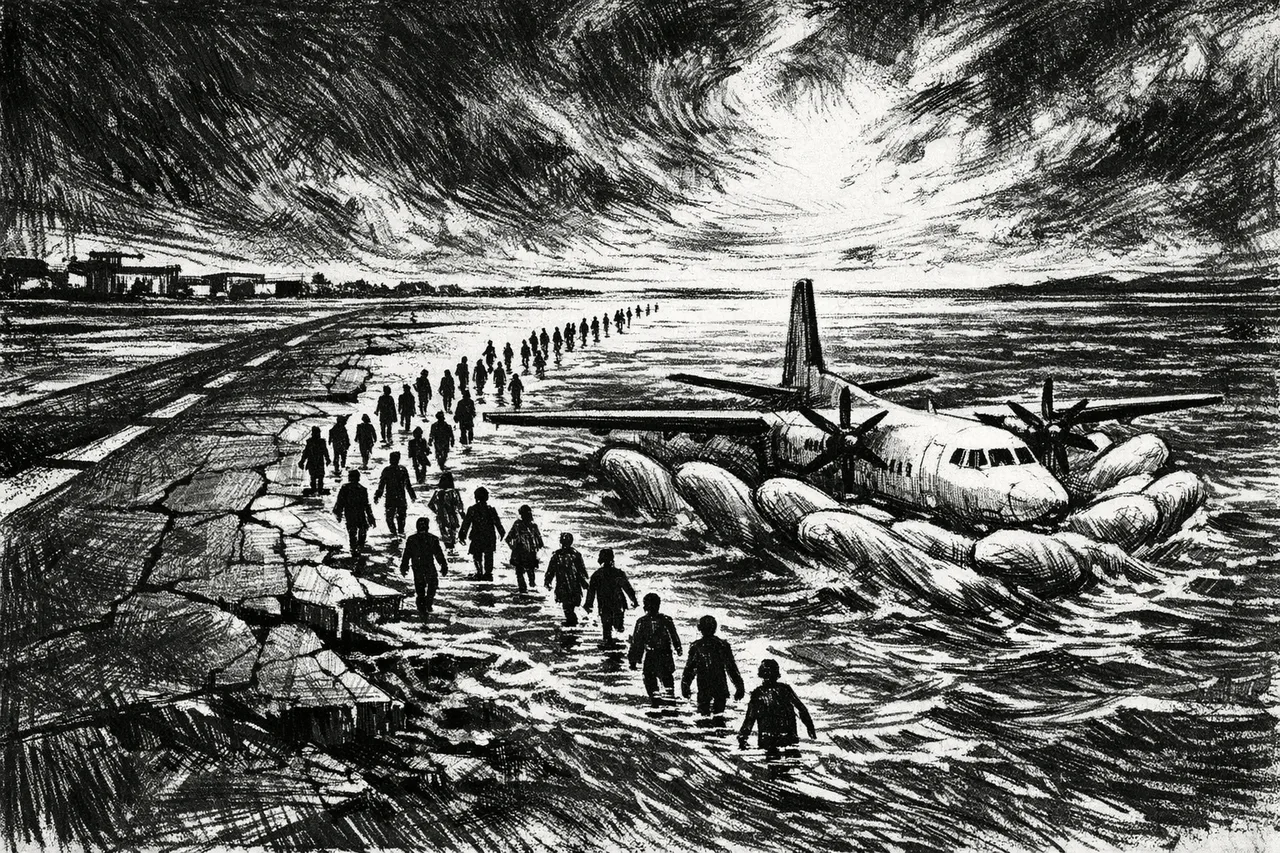
Picture this: You're 15 minutes into a routine flight over Somalia when something feels wrong. The plane turns back. Tires squeal. Metal groans. Instead of pavement outside your window, you see turquoise water rushing closer. The aircraft shudders to a halt in knee-deep ocean, sand beneath the fuselage, waves lapping at a broken wing. You unbuckle, wade through shallow surf, and walk away.
All 55 of you.
That's exactly what happened on February 10, 2026, when a Starsky Aviation Fokker 50 turboprop overshot the runway at Mogadishu's Aden Abdulle International Airport and came to rest on the Indian Ocean shoreline. Zero fatalities. Zero serious injuries. Just a surreal image of a commercial aircraft parked on a beach like some mechanical whale that miscalculated high tide.
What Actually Happened
At 1:17 p.m. local time, the Fokker 50 carrying 50 passengers and five crew was about 15 minutes into its flight to Gaalkacyo when the crew detected a problem. They requested an emergency return to Mogadishu. The touchdown appeared normal, but the aircraft couldn't stop. It overran the runway, veered off the tarmac, slid down a small embankment, and stopped in shallow water on the sandy beach.
The aircraft took serious damage, including a fractured wing, but the fuselage stayed intact. Crew members ordered immediate evacuation. Passengers waded to safety through ankle-deep water. UN and African Union troops stationed near the airport arrived within minutes. Everyone was accounted for, evaluated at a hospital as precaution, and released.
Transport Minister Mohamed Farah Nuh confirmed all survived. Somali Civil Aviation Authority launched its investigation. Starsky Aviation spokesman Hassan Mohamed Aden issued the corporate version: "The pilot's swift and calm decision-making played a decisive role in ensuring the safety of everyone on board."
Translation: This could have been catastrophic.
The Invisible Decision Stack
When airlines praise "quick thinking," they're compressing a cascade of split-second choices most of us never consider.
First, recognizing something's wrong 15 minutes out. Not catastrophic yet, but abnormal enough to turn back. Next, communicating with air traffic control to coordinate emergency landing clearance. Then, managing approach with a potentially compromised aircraft, balancing speed and control. Finally, attempting to land knowing the plane might not stop in time.
Here's what matters: A good emergency landing isn't graceful. It's controlled energy management. The pilot's job isn't to make it pretty. It's to make it survivable.
The runway at Mogadishu borders the Indian Ocean. There's no grassy overrun area, just water. That geography forced a choice: attempt to stop or aim for the least dangerous off-runway terrain. The shallow water and sand acted as a crude arresting system, absorbing energy that concrete would have violently reflected back into passengers.
Why Overshooting Doesn't Automatically Mean Disaster
Our brains hear "plane crash" and think fireball. Physics doesn't care about Hollywood.
Speed matters more than location. Shallow water and compact sand create high drag. They distribute deceleration forces differently than hitting a concrete barrier. The Fokker 50's relatively low speed as a turboprop worked in its favor.
Structure matters more than spectacle. The fuselage remained intact, which meant exits stayed usable and passengers weren't crushed. A snapped wing sounds dramatic, but if the cabin holds together and there's no post-impact fire, survival rates skyrocket. Older aircraft designs often prioritize rugged durability over lightweight efficiency.
What this means for you: The next time you see dramatic crash footage, remember that outcomes depend on physics, not luck. Energy at impact, structural integrity, and evacuation speed determine who walks away.
The Airplane: A Workhorse Showing Its Age
The Fokker 50 is a Dutch-designed turboprop from the late 1980s, still flying routes worldwide because it's reliable and can operate from rough runways. But reliable and maintenance-intensive aren't contradictory.
In Mogadishu, age meets a hostile environment. Hot coastal air, sand particles, and salt spray accelerate wear on engines and surfaces. Maintenance isn't just following a checklist. It's anticipating how equipment degrades faster in specific conditions.
Starsky Aviation, founded in 2013, operates a small fleet of these turboprops on domestic routes where road travel can be slow or unsafe. The economics are practical: proven aircraft, short hops, limited infrastructure. But margins shrink when you combine aging metal with thin regulatory bandwidth.
Somalia's Civil Aviation Authority is investigating the same month international carriers flagged airport security concerns. That creates an uncomfortable question: How objective can oversight be when the overseer is also under scrutiny?
When Your Runway's Neighbor Is the Ocean
Aden Abdulle International Airport sits on the Indian Ocean coastline. Any runway excursion doesn't just risk obstacles. It risks drowning.
Yet in this case, coastal geography may have softened the outcome. Instead of a sudden halt against a wall, the aircraft slid down an embankment into forgiving water. Shallow enough to prevent sinking, deep enough to slow the plane progressively.
It's a paradox: The same hazard that makes the airport operationally challenging may have cushioned this particular crash. Aviation safety isn't about avoiding risk. It's about managing how risks interact.
Context Without Politics
Somalia's aviation sector operates under conditions most Western travelers can't imagine.
In January 2026, multiple international airlines warned they might suspend Mogadishu flights over security fears. Since 2024, there's been ongoing air traffic control conflict with Somaliland. The SCAA is recognized internationally but faces obvious capacity constraints.
This incident adds to a concerning pattern. In July 2022, a Jubba Airways Fokker 50 flipped on landing at the same airport. Everyone survived, but the image was jarring. In January 2024, a Jetways Airlines Fokker 50 on a UN cargo flight veered off a remote runway, killing the pilot. Three notable Fokker 50 incidents in Somalia in four years.
Domestic aviation in Somalia isn't luxury. It's essential infrastructure where roads are often impassable or insecure. That demands modernized oversight, fleet renewal, and honest assessment of whether aging aircraft save money today but cost lives tomorrow.
When Everyone Does Their Job
Survival is a chain reaction.
After the aircraft stopped, there was a brief pause. Passenger Odowa described that moment of silence before evacuation, the surreal realization they were alive. Then doors opened. Crew urged quick exit. Passengers helped each other wade through water, some clutching bags because shock makes you default to routine.
UN and AU personnel deployed within minutes. Airport fire services prioritized preventing post-impact fire. No one panicked enough to block exits. No one heroically stayed behind in a burning fuselage because there was no fire.
The quiet heroics were competence: training that kicked in, systems that worked as designed, enough luck that worst-case stayed hypothetical.
The Real Miracle Is Margin
The miracle isn't divine intervention. It's structural integrity plus pilot decisions that minimized energy at impact plus crew evacuation discipline plus rapid response.
In an industry where safety margins are measured in meters and seconds, this outcome reflects a system that mostly held together when stressed. The story isn't that 55 people survived a plane crash. It's that competence and preparation created enough margin for error that potential catastrophe became dramatic inconvenience.
The punchline writes itself: In aviation, a perfect flight is one where you complain about legroom. A perfect emergency landing is one where you complain about wet shoes.
What Happens Next
The investigation will determine the technical fault. Maintenance records will be scrutinized. Runway condition and aircraft performance data will be analyzed. Starsky Aviation grounded the aircraft and is cooperating.
The deeper question is whether Somalia's aviation sector will modernize. State Minister for Aviation Abdikarim Abdow Haydar publicly urged domestic carriers to "replace ageing aircraft with newer models to reduce risks." That's a notable admission, but it requires investment and regulatory teeth.
For now, 55 people have a story that will dominate every family gathering. The pilot remains unnamed but hopefully gets a beer and a day off. And the rest of us get a reminder that aviation safety isn't about perfection. It's about building systems that can handle imperfection.
The plane on the beach will be towed away. Headlines will move on. But questions about aging fleets, regulatory oversight, and essential infrastructure in challenging environments remain. Those questions deserve our curiosity more than the spectacle of a turboprop in the surf.