
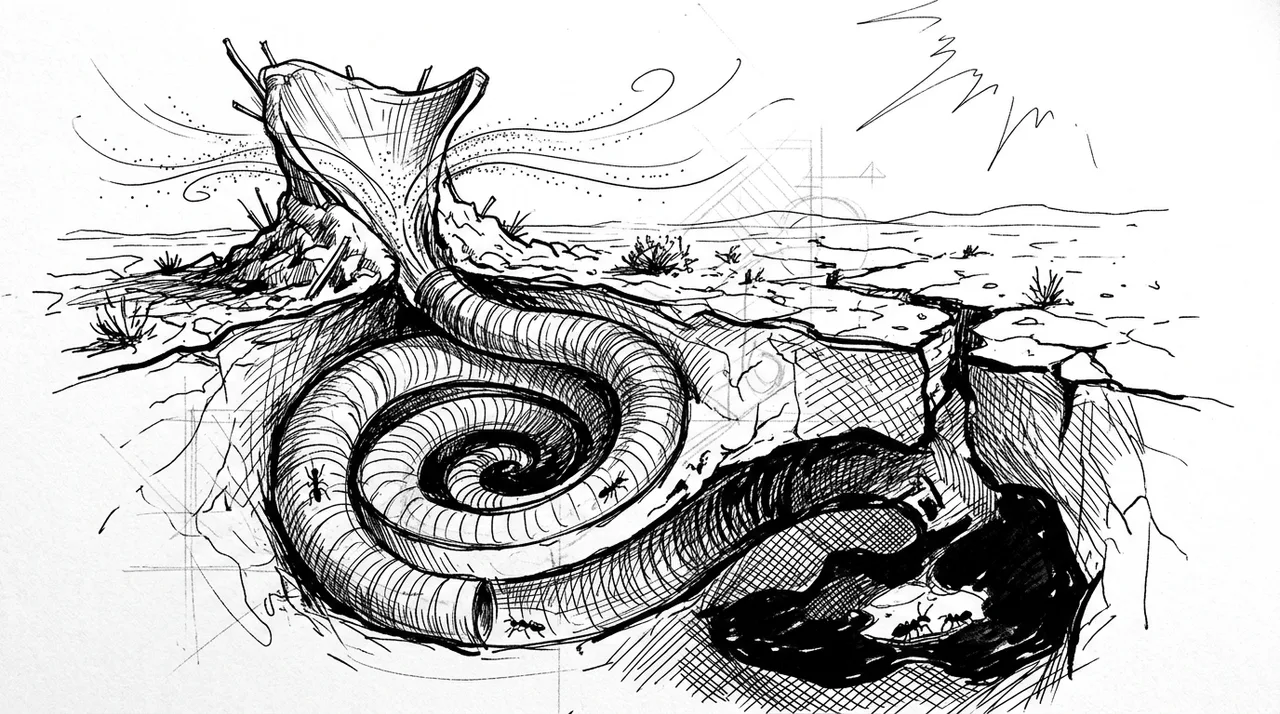
TLDR: Two-thousand-year-old ant nests in the Negev Desert used helical tunnels and wind-catching entrances to passively cool interiors 5-10°C below surface temperature. The evolutionary design, validated by computational models, offers a biomimetic blueprint for slashing modern cooling energy by up to 50% in arid climates.
Here is a sentence that should not make sense: Two thousand years ago, in a desert so brutal it makes August in Phoenix look forgiving, ants built nests that stayed cool using nothing but geometry, wind patterns, and the physics of airflow. Wait, what?
The discovery comes from the Negev Desert, a stretch of arid land sharing the Sahara's punishing temperature swings but sitting slightly northeast, in modern-day Israel. There, researchers from Ben-Gurion University of the Negev uncovered fossilized nests of Messor arenarius harvester ants. Flash floods had buried these structures centuries ago, preserving them like time capsules beneath layers of sediment. Radiocarbon dating and stratigraphy place the nests at roughly 2,000 years old, but their age is not the remarkable part. Their architecture is.
The nests descend up to four meters deep. They feature vertical chimneys, helical tunnels that spiral like DNA strands, and Y-shaped entrance halls strikingly similar to the windcatchers still found in traditional Persian architecture. According to Prof. Dror Hawlena, who led the research at BGU, these structural patterns represent something previously unseen in the archaeological record:
"These ants engineered sophisticated climate control systems long before humans, challenging our assumptions about 'primitive' species."
We're talking about harvester ants, insects with brains roughly the size of a grain of sand, building underground complexes that manipulate airflow like a textbook on passive ventilation.
How the Physics Works (Without the Electricity Bill)
The cooling mechanism is pure passive ventilation, the kind of design that makes sustainability architects quietly dream. Here is the short version: hot air rises. When desert winds hit those Y-shaped entrances at specific angles, they create pressure differentials that draw cooler subterranean air upward while pushing warmer internal air out through the vertical chimneys. The spiral tunnels act as fluted channels, slowing and directing airflow to maximize heat exchange. No refrigerant. No compressor. Just a shape that lets the wind do the work.
Computational fluid dynamics models suggest these structures could keep internal temperatures 5 to 10 degrees Celsius cooler than the desert surface outside. As Dr. Shani Innes noted in the study's findings:
"The nests maintain 25-30°C gradients, purely through form and physics."
Think about that the next time you crank the AC in July. These ants did not invent refrigerant. They built a shape that cooperates with physics rather than fighting it.
The Skepticism Check (Because Headlines Lie)
Before we start calling ants "tiny engineers" or imagining they held subterranean planning committees, let's pump the brakes. The nests are real. The geometry is real. The cooling potential, supported by computer modeling, is plausible. But ants are not conscious inventors. They didn't sketch blueprints or conceptualize "climate control" the way a human engineer would.
What we're seeing is evolution through trial and error across millions of years. The Messor arenarius ants whose nests failed to manage heat died. The ones whose structures happened to catch the wind just right survived and passed those behavioral tendencies down. Sophisticated, yes. Sentient engineering, no.
It's also worth noting that we cannot stick a thermometer into 2,000-year-old fossilized air pockets to verify exact temperatures. The 5 to 10 degree figure comes from computer models, not direct ancient measurement. Biomimicry stories often leap from "nature does something cool" to "this will transform cities overnight," and that jump helps nobody. The wonder isn't that ants are tiny people. The wonder is that evolution, through sheer time and selection pressure, can solve problems that humans still approach with brute-force energy consumption.
Why Architects Are Taking Notes
That said, the design logic is real and increasingly relevant. Biomimicry, the practice of borrowing nature's design principles rather than copying nature literally, has long looked at termite mounds and passive cooling strategies. The Eastgate Centre in Zimbabwe already uses thermal mass and natural ventilation to cool a large office building without conventional air conditioning. That's not science fiction. It's physics applied skillfully.
These ant nests offer a refined variation on that approach. The specific geometry of those spirals and chimneys could inform ventilation design in arid climates, with analyses in the broader biomimicry field projecting 30 to 50 percent reductions in HVAC energy demands for new constructions built around these principles. For off-grid communities in desert regions, and for cities staring down increasingly brutal heat waves, the lesson is clear: sometimes the smartest machine is a well-designed hole in the ground that knows how to breathe.
The Evolutionary Question Nobody Asked
Which brings us to the part that sits a little uncomfortably. If insects with brains smaller than a pinhead can produce climate stabilization systems that rival human engineering, what does that say about our definition of intelligence?
Individual ants are not geniuses. Collectively, though, their behavior plus millions of years of evolutionary pressure has produced solutions that humans, with all our conferences and computing power, are only now rediscovering. We tend to assume complexity requires big brains and deliberate planning. The Negev nests suggest it might only require time, selection pressure, and the ruthless efficiency of physics.
Perhaps the deeper lesson is about our relationship with comfort. We've gotten extraordinarily good at overpowering nature, burning enormous amounts of energy to push desert heat away with refrigerated air. These ants suggest an alternative: work with the constraints. Use the wind. Let the heat rise. Build shapes that cooperate with the environment instead of declaring war on it. That's not anti-technology. It's just better design.
The Takeaway
Two thousand years ago, ants in a desert climate akin to the Sahara built nests that stayed measurably cool through spiral tunnels and the stack effect alone. No, they were not geniuses. Yes, the physics are sound. And yes, we might finally be ready to learn from them.
The next time someone tells you sustainable design requires futuristic technology, point them toward a four-meter-deep ant nest in the Negev. The future of architecture might not be a smarter machine. It might just be a humbler shape, patiently waiting for the wind to change.