
TLDR: A mysterious golden orb found 3,250 meters deep in the Gulf of Alaska turned out, after 2.5 years of analysis, to be basal tissue and cuticle from the rare giant deep-sea anemone Relicanthus daphneae—and even a tiny microbial microhabitat. The delay came from a damaged, degraded sample that defeated quick DNA barcoding, forcing scientists to combine microscopy, taxonomy, and full mitochondrial genome sequencing to solve the case.
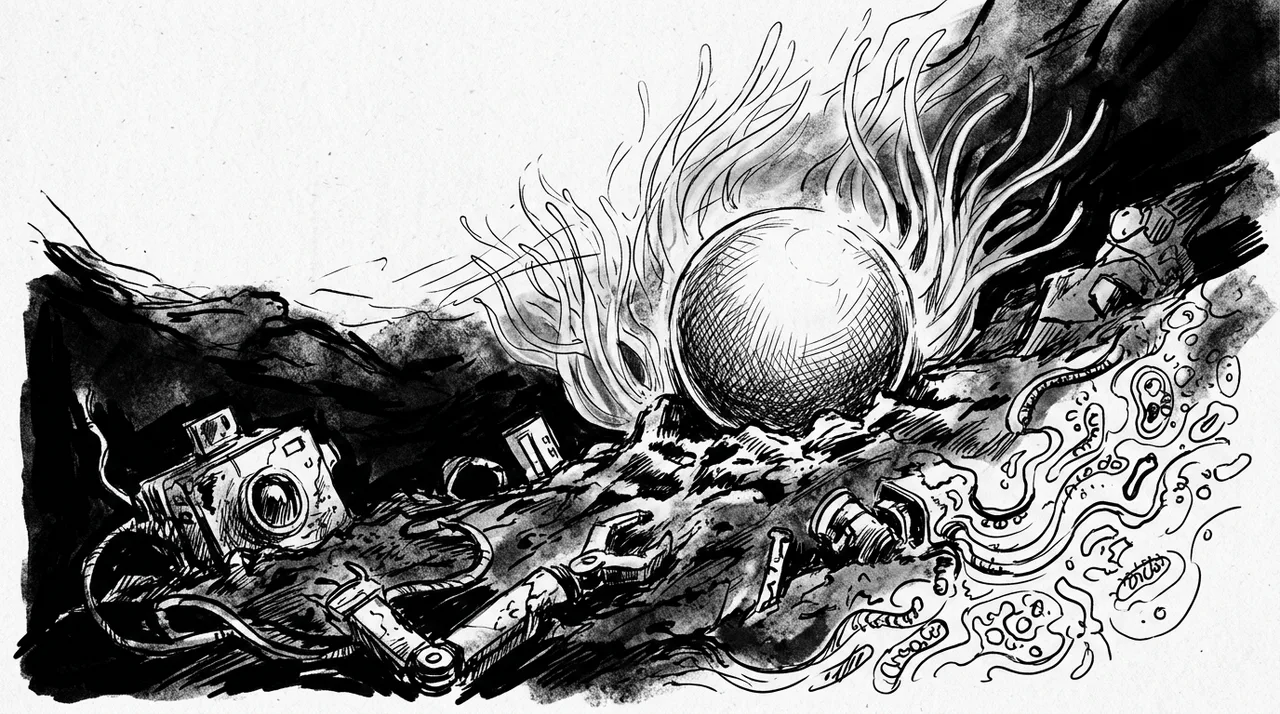
In August 2023, during a NOAA expedition in the Gulf of Alaska, a remotely operated vehicle came across something that looked less like a normal sea creature and more like a prop from a very patient sci-fi movie: a smooth, shiny, golden blob about the size of a softball, stuck to a rock more than 3,250 meters below the surface. It had a torn opening in it, which naturally prompted the kind of guesses humans are contractually obligated to make when confronted with a weird orb. Egg case? Sponge? Evidence that something had crawled in, or worse, out?
That "wait, what?" moment spread fast. But the more interesting story was never just what the orb looked like.
In late April 2026, NOAA and the Smithsonian finally announced what it was. And the best part of the story is not the answer alone. It is why it took two and a half years to say that answer with confidence.
The Answer, Up Front
The object turned out to be basal tissue and cuticle from the giant deep-sea anemone Relicanthus daphneae. In plain English, it was not a whole, tidy animal. It was leftover material from the anchoring base of a rare anemone that had been attached to rock.
That helps explain why it looked so baffling. Scientists were not looking at a recognizable creature with tentacles waving around like a helpful label. They were looking at biological leftovers.
The orb also turned out to be more than a scrap. Researchers described it as a "novel microhabitat," with microbial communities living on and beneath the remnant material. So the golden blob was not only part of an anemone. It was also a tiny ecosystem.
Once you know that, the next question becomes obvious: if that is what it was, why did it take so long?
Why the Identification Took 2.5 Years
The short version is that the sample was a bad candidate for a quick ID.
It was damaged, dead tissue with no obvious animal features. No mouth, no gut, no clear anatomy. Instead, it was a fibrous mass with a smooth layered surface. That is a lot less helpful than, say, "this fish has fins and looks very fish-shaped."
The first round of genetic testing did not help either. Initial DNA barcoding was inconclusive because the sample was degraded and contaminated with microbial DNA. If you have not heard of DNA barcoding, think of it as the quick first pass: scientists test a standard genetic marker and check for a match among known species. It often works. Here, it did not. So researchers had to move to whole mitochondrial genome sequencing, a slower and more detailed process that ultimately gave them a strong match.
All of that took time, and not because anyone was dragging their feet. Allen Collins, zoologist and director of NOAA Fisheries' National Systematics Laboratory, which is housed at the Smithsonian National Museum of Natural History, said his lab works through hundreds of samples at a time. He expected routine methods to solve this one. Instead, it became what he called a "special case" demanding multiple kinds of expertise.
This was not one person peering at a blob under a lamp and declaring victory. Researchers combined light microscopy, taxonomy, genetics, deep-sea biology, and bioinformatics. Under the microscope, Smithsonian scientist Abigail Reft identified specialized stinging structures unique to Hexacorallia, the group that includes sea anemones and stony corals. Advanced sequencing then linked the orb to a 2021 specimen and a reference genome for Relicanthus daphneae.
Internet mystery culture works in hours. Marine biology, especially when your specimen is basically an orphaned anemone foot, works a little differently.
Why This Species Was Especially Hard to Recognize
The orb was not just damaged. It also belonged to a species that is genuinely rare and strange.
Relicanthus daphneae has been recorded only about 30 times worldwide. It lives at depths of roughly 1,200 to 4,000 meters, in places that humans do not visit often or easily. First described in 2006, it was later reclassified into its own genus and suborder, which is scientific shorthand for "this thing is unusual enough that we had to rethink where it belongs."
Its full body does not match the tidy cartoon idea of a sea anemone either. This is a giant deep-sea cnidarian with a cylindrical body and pale pink or purple tentacles stretching more than two meters. It lives attached to hard surfaces like rocks and extends those tentacles into passing currents to capture prey. The golden base is normally hidden beneath the animal, so even someone familiar with marine life would not necessarily recognize it from the base alone.
The 2021 comparison specimen mattered, too. Matching the Alaska orb against another example of the same species, then confirming both against a known reference genome, helped rule out that this was just "some cnidarian-ish material." It was specifically Relicanthus daphneae.
What the Golden Orb Reveals About Deep-Sea Science
The orb is a good reminder that deep-sea science is not slow because scientists enjoy suspense. It is slow because the work is genuinely difficult.
Access is limited. To find anything at these depths, researchers need specialized ships, remotely operated vehicles, and a lot of planning. You do not walk into the deep ocean with a net and a notebook.
Encounters are rare. Many deep-sea animals are seen only occasionally, which means there are few specimens to compare against.
Samples are messy. By the time damaged tissue is collected, brought up from extreme pressure and cold, preserved, and analyzed, it may already be missing the features that would make identification straightforward. Contamination is a constant obstacle, especially when microbes are living on the sample itself.
That is why visual identification alone rarely closes a case. Physical structure and genetic analysis have to work together, and the evidence builds slowly, through accumulated clues rather than single breakthroughs.
That gets to the deeper lesson. Viral moments happen fast because they run on novelty. Careful science moves slowly because it runs on confidence. "We don't know yet" is less satisfying than a dramatic guess, but it is also how real knowledge gets made.
The Bigger Takeaway
The golden orb mystery is satisfying because it finally has an answer. But the bigger payoff is seeing what that answer required: years of patient work, multiple specialties, better sequencing, and a willingness to keep following the evidence after the easy explanations failed.
The deep ocean still holds plenty of organisms that are difficult to classify from a quick look, especially when what gets collected is only part of the story. Some uncertainty remains here, too. Scientists still do not know exactly what happened to the rest of the anemone. And as of late April 2026, the research paper is still under journal review.
That does not make the story weaker. It makes it more honest.
Deep-sea science is not a machine for instant answers. It is a slow human process built on patience, collaboration, and the willingness to look at a strange golden blob on the seafloor and say, with admirable restraint, "That's strange. Let's keep looking."