
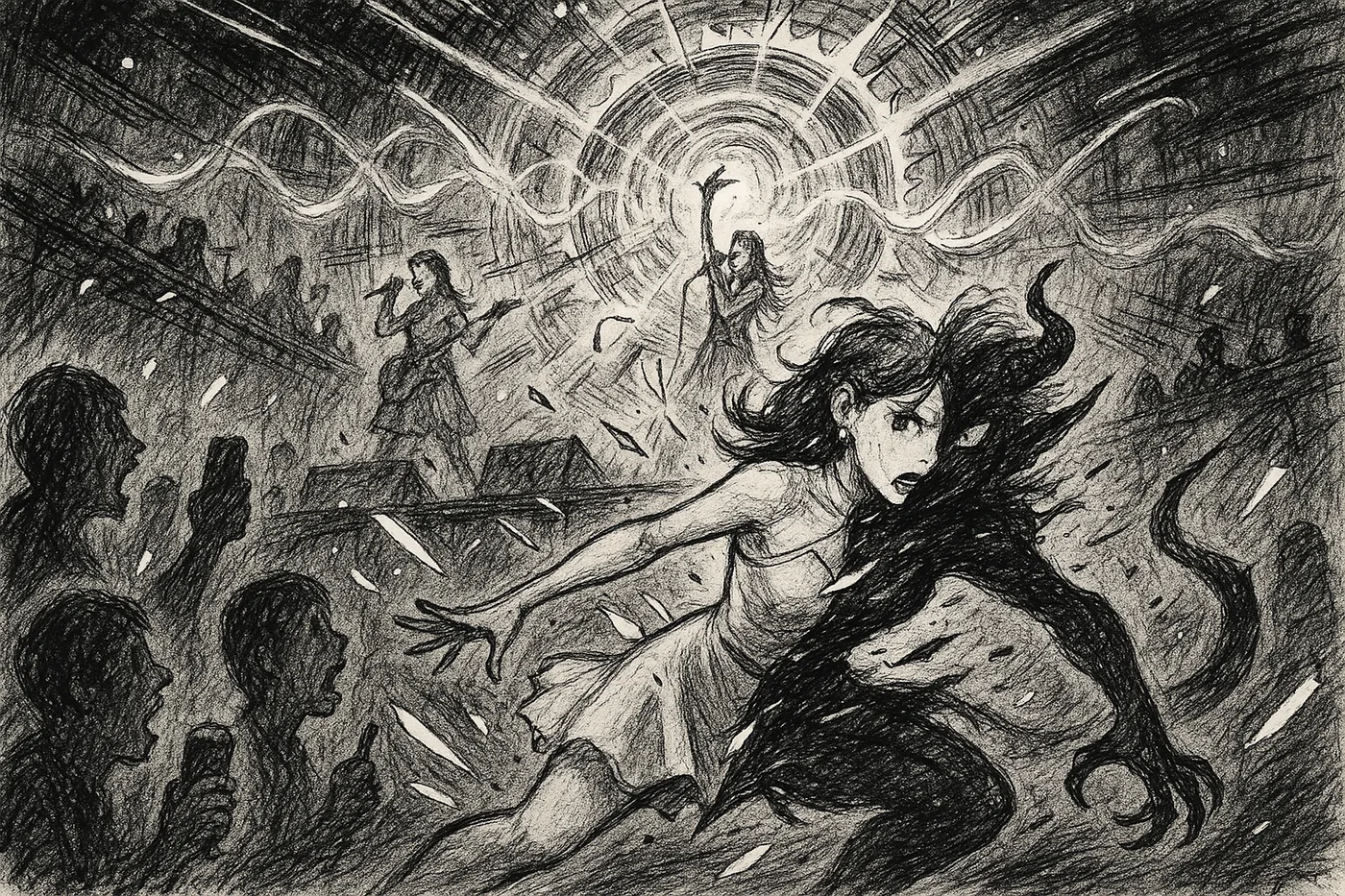
TLDR: KPop Demon Hunters scoring three Golden Globe nominations isn’t just a “lol K‑pop demon slayers” moment—it marks a Korean-Canadian woman, Maggie Kang, using a glossy, record-breaking blockbuster to smuggle in a story about identity, shame, and perfection under global scrutiny. Built first on Korean mythology and only later layered with K‑pop, the film fuses Seoul folklore, anime‑inspired visuals, and North American spectacle into a distinctly diasporic universe where a girl group’s stadium shows secretly hold back demons. At its core is Rumi, a half‑demon idol whose hidden side becomes a metaphor for every “unacceptable” part of yourself you’ve been told to sand down, with the hit song “Golden” doubling as both a fantasy of flawless idols and a critique of that ideal as her golden armor literally shreds away. The movie loves K‑pop’s craft and community while quietly skewering its machine—contrasting hollow, death‑god‑themed rival boys with Huntrix’s vulnerable, soul‑driven tracks—and its runaway success (Netflix’s biggest film ever, chart‑shattering soundtrack, awards momentum) is the industry’s belated acknowledgment that unapologetically specific, female‑led, hybrid storytelling can define the mainstream. Underneath the demons and dance breaks, the film is really about hunting down the idea that there’s only one correct way to be Korean, to be an idol, or to be a girl—and building a new “golden barrier” around the right to be fully yourself.
Two days ago, the 2026 Golden Globes nominations dropped. Among the usual prestige suspects, one title stands out:
KPop Demon Hunters—the movie about a K‑pop girl group who secretly hunt demons—just scored three nominations: Best Motion Picture – Animated, Best Original Song for "Golden," and Cinematic and Box Office Achievement.
K‑pop demon slayers at the Golden Globes. Wait, what?
Sure, it's Netflix's most popular film ever. The soundtrack broke Billboard records. TIME named it "Breakthrough of the Year." But if you stop at "lol wild concept," you miss the real story: Korean-Canadian animator Maggie Kang used pop spectacle to explore identity, shame, and the cost of perfection under a global spotlight.
This is cultural fusion and creative rebellion disguised as a banger-filled blockbuster.
From Seoul To DreamWorks To Netflix's Biggest Hit
Maggie Kang was born in Seoul around 1982 and moved to Toronto at five. Home was Korean; school was Canadian; her brain held both. She studied animation at Sheridan College, got recruited to DreamWorks in her third year, and climbed from story artist (Puss in Boots, Kung Fu Panda 3) to head of story (The Lego Ninjago Movie) to director at Sony Pictures Animation.
She's described learning her craft in studio cafeterias, trading notes over lunch with other artists. That informal mentorship pipeline has thinned—and it was never designed for Korean-Canadian women to run the show.
Kang's response? Make this movie. She wanted a story "set in Korean culture," mining mythology and demonology for something mainstream animation hadn't centered. Most importantly, she wanted "a group of amazing kick‑ass women" who were funny, silly, goofy, messy—not perfect idols.
Human girls who happen to be idols. That crack is where the film's critique of fame begins.
K‑Pop Came Last (And That Matters)
Here's the twist: when Kang pitched the project in 2018, the "K‑pop" part came last.
The core was always Korean mythology:
- Ancient demon hunters
- A metaphysical barrier called the Honmoon, made of sound and light
- Demons that look nothing like Western monsters
The K‑pop layer arrived later: a girl group named Huntrix (HUNTR/X) whose stadium performances secretly power the Honmoon and protect humanity. Suddenly you've got mythology, superhero secret identities, idol culture, and a question about who you're allowed to be when millions are watching.
That fusion feels distinctly diasporic. Kang's childhood memories of K‑dramas mix with North American blockbuster storytelling. The music production spans Seoul to New York—heavyweight K‑pop producers like TEDDY and Lindgren working alongside Broadway veteran Ian Eisendrath.
Visually, the hybridity goes deeper. Production designer Helen Mingjue Chen created concept art for sonic-light weapons literally formed from the Honmoon—a visual metaphor for invisible lines between worlds and identities. Visual development artist Nacho Molina drew from Sailor Moon backgrounds and concert lighting to paint a romanticized Seoul that feels both Korean and global.
Even the food matters. Art director Scott Watanabe designed entire sheets of the girls "chowing down" on kimbap in ways that are deliberately "not ladylike." These girls eat. A lot. On screen. That's not an accident.
Kang has said that after seeing Sony's Spider-Verse films, she and co-director Chris Appelhans chose not to copy that hybrid 2D–3D look. Instead, they pushed bold 3D animation with "faces and the look and feel of anime" that fit this story.
This isn't "what worked last time?" It's "what does it look like where my cultures actually meet?"
The Part You Hide Is The Part That Saves Everyone
At the center sits Rumi, Huntrix's leader, who is secretly half‑demon. She's powerful, charismatic, and drowning in shame about the part of herself she can't fully hide or accept.
If you've ever felt "too much" or "not enough" for any box you're put in, Rumi is you with better choreography.
Lyricist EJAE, who co-wrote "Golden" and spent a decade as a K‑pop trainee, said this idea of shame and hiding flaws is painfully familiar. In K‑pop, mistakes can be career-ending; perfection isn't a vibe, it's a job requirement. Rumi's demon side becomes a metaphor for every part of yourself you've been taught to smooth over to be lovable, employable, "brand‑safe."
"Golden" sits right on that fault line.
Within the film, it's Huntrix's big "I want" song—they're chasing the Golden Honmoon, an ultimate barrier that will keep demons out forever. Shiny gold costumes. Choreography built to go viral.
But co-director Appelhans has said the gold costumes represent a dream of being "perfect and beyond reproach." When Rumi's costume literally tears away later, that glittering fantasy shreds with it.
The Golden Globes nomination for Best Original Song lands on a track that both feeds and questions our obsession with perfection. And in real life, "Golden" hit No. 1 on the Billboard Hot 100 and Global 200, topped charts in 30+ countries, and earned multiple Grammy nominations.
It was designed as a smash in a fictional universe. It became one in ours.
Then there are the Saja Boys, the rival demon boy band literally tied to Korean death gods. The filmmakers crafted their songs to be "super catchy, but slightly hollow, like there's no real soul underneath," while Huntrix's tracks feel emotionally vulnerable and honest.
Critics have called the movie both a "love letter to K‑pop" and a blunt examination of its culture. It adores the spectacle but side‑eyes the way people get packaged, polished, and sold until there's nothing left but choreography and merch.
The sympathy is with the girls and the fans, not the machine.
Why Awards Voters Finally Paid Attention
By now, KPop Demon Hunters is a data point in a changing industry:
- Netflix's most popular film of all time
- First Netflix film to top the U.S. box office (sing‑along theatrical event)
- First soundtrack to land four songs in the Billboard Hot 100 Top 10 simultaneously
- New York Film Critics Circle winner for Best Animated Feature
- TIME's "Breakthrough of the Year"
- On the Oscars longlist for Best Animated Feature
The three Golden Globes nominations (ceremony January 11, 2026) signal the establishment recognizing something bigger: a Korean-Canadian woman built a hyper-specific, myth-soaked, girl‑powered universe that refused to flatten itself into "generic Asian content," and audiences worldwide demanded more.
A sequel is planned for 2029, with Kang writing. What started as an immigrant kid's hybrid imagination is now its own expanding universe.
The Real Demon Hunting
The demons in this story aren't just CG creatures. They're shame, impossible standards, and the idea that there's only one "right" way to be Korean, to be an idol, to be a girl.
If you've already watched KPop Demon Hunters, notice where the movie loves K‑pop (the precision, the fandom) and where it calls out its darker edges (control, perfection, commodification). Watch Rumi's "demon" moments as stand-ins for any part of yourself you've been told to hide. Look in the corners: the food, the city, the way girls laugh with their mouths full. That's Maggie Kang's Korean‑Canadian life sneaking into a global blockbuster.
The real Golden barrier we're building isn't just around the world. It's around our right to be fully ourselves on screen and off.