
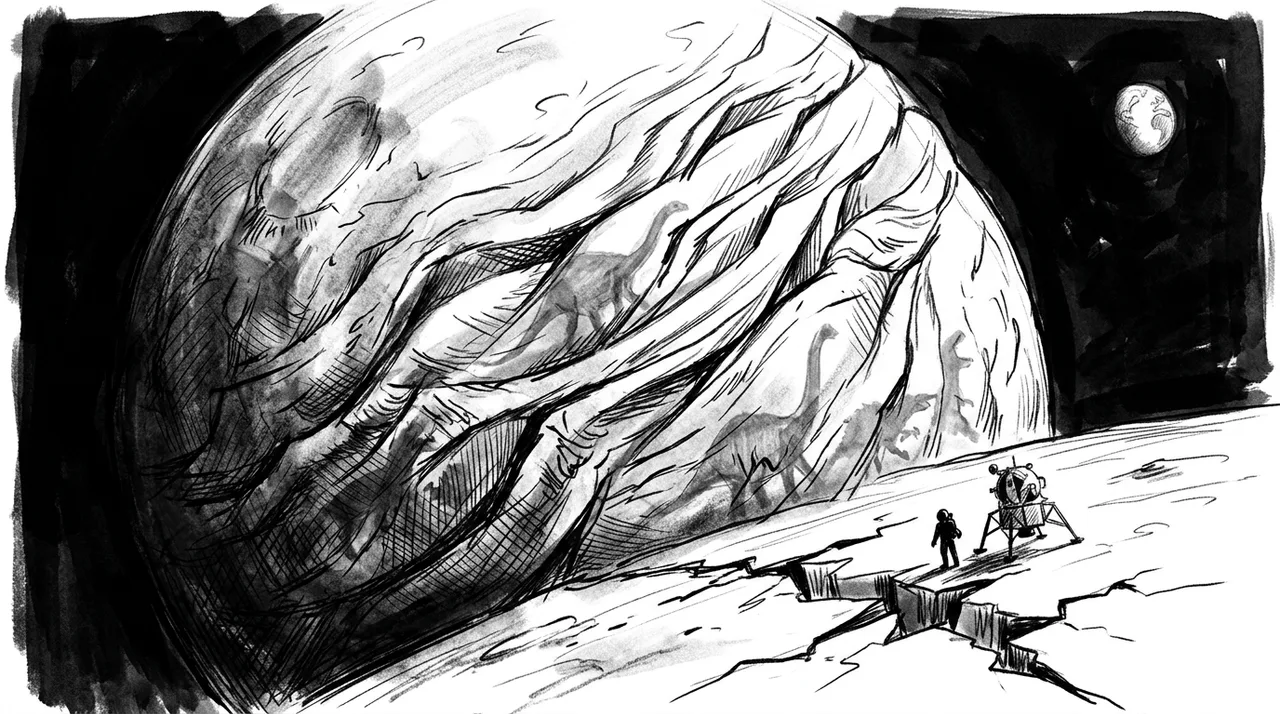
TLDR: The Moon is actively shrinking and forming new thrust faults as its interior cools. Scientists discovered 1,114 previously unrecognized ridges averaging just 124 million years old—formed while dinosaurs roamed Earth—expanding the map of seismic hazards near the lunar south pole where NASA plans to land.
Most of us grew up picturing the Moon as frozen in time. A dead rock hanging in space. A cosmic museum piece that stopped changing roughly three billion years ago, interrupted only by the occasional meteorite impact.
That picture is incomplete.
The Moon is shrinking. Not dramatically, and not in any way you would notice through a backyard telescope. But over tens of millions of years, its interior has been cooling, and as it cools, it contracts. Our satellite has lost roughly 100 meters of radius to this slow process. Just as a grape wrinkles when it dries into a raisin, the Moon's crust buckles as the surface compresses. The difference: grape skin is flexible. Lunar crust is brittle. So instead of soft folds, you get cracks, thrust faults, and ridges.
Scientists just finished mapping these wrinkles in unprecedented detail, and the results have that perfect "wait, what?" quality.
1,100 Ridges No One Had Cataloged Before
Researchers at the Smithsonian Institution's Center for Earth and Planetary Studies built the first global map of small mare ridges, or SMRs, low-profile wrinkles that form exclusively in the Moon's dark volcanic plains, called maria. Using high-resolution imagery from NASA's Lunar Reconnaissance Orbiter, the team identified 1,114 previously unrecognized SMR segments on the lunar near side, bringing the total known count to 2,634 segments worldwide. The findings were published in The Planetary Science Journal in December 2025.
"Since the Apollo era, we've known about the prevalence of lobate scarps throughout the lunar highlands," said lead author Cole Nypaver, a research geologist at the Center for Earth and Planetary Studies. "But this is the first time scientists have documented the widespread prevalence of similar features throughout the lunar mare."
To be clear about what SMRs actually look like: modest. These ridges stand only tens of meters high, barely noticeable in a broad landscape. But modest does not mean meaningless. They are geological signatures of ongoing crustal compression, and mapping them changes our sense of how active the Moon really is.
The mechanics behind them are the same as for the better-known lobate scarps found in the lunar highlands: compressional forces drive rock up and over adjacent crust along a thrust fault, leaving a ridge behind. In fact, lobate scarps and SMRs are sometimes literally connected, one transitioning into the other where highland terrain meets the flat maria. Same origin, different terrain. None of this resembles Earth's plate tectonics. The Moon has no moving plates. What it has is a shrinking interior pushing steadily outward against its own rigid shell.
The Part That Should Make You Stop
Here is the number that reframes everything: 124 million years.
That is the average age of these small mare ridges, with individual features ranging from roughly 50 to 310 million years old. That closely matches the average age of lobate scarps, clocked at about 105 million years. For comparison, the Moon itself is 4.5 billion years old.
In geological terms, 124 million years is recent. As in: the Moon was still actively forming these wrinkles while non-avian dinosaurs were alive on Earth. That challenges the long-held assumption that the lunar maria have been geologically inert for billions of years.
Co-author Tom Watters, a senior scientist emeritus at the Center for Earth and Planetary Studies, put it plainly: "Our detection of young, small ridges in the maria, and our discovery of their cause, completes a global picture of a dynamic, contracting moon."
Dynamic. Contracting. Today.
Wrinkles That Can Shake the Ground
Young faults are not just a geological curiosity. They are potential sources of moonquakes.
Because SMRs arise from the same thrust-fault mechanics as lobate scarps, and because lobate scarps are known to generate seismic activity, SMRs expand the map of where moonquakes could originate. Apollo seismometers recorded shallow moonquakes between 1969 and 1977, and at least eight of those events have been modeled as fault-slip events on similar structures. The strongest had its epicenter near the lunar south pole.
The new map means seismic risk may be far more widespread across the maria than scientists previously recognized. Shallow moonquakes can produce strong ground shaking tens of kilometers from their source. In certain areas, particularly near permanently shadowed regions at the south pole, even light seismic shaking could trigger landslides in loose surface material.
Why This Matters for Humans on the Moon
NASA's Artemis program plans to establish sustained human presence on the Moon, with early crewed landings targeting the south polar region. Sites near Shackleton Crater and de Gerlache Rim already sit close to young thrust faults identified in related research. A brief mission faces relatively low odds of encountering hazardous seismic shaking. A permanent outpost faces much longer exposure to those same odds, making fault locations a genuine engineering variable, not a footnote.
The broader value of the new SMR map is that it helps complete the global picture of lunar contraction, giving mission planners a more accurate view of where the ground might move. As Nypaver noted, a better understanding of lunar tectonics and seismic activity "will directly benefit the safety and scientific success" of upcoming missions.
Better maps before we build. That is the practical logic here.
The Moon Has Been Keeping Secrets
The Moon is not a static relic. It has been slowly shrinking, wrinkling, and occasionally shaking for millions of years, quietly and without anyone down here grasping the full picture.
The more closely we map it, the stranger and more alive it becomes. Future lunar exploration depends as much on understanding the ground underfoot as on getting there in the first place. Before permanent bases go up, we need to know where the faults lie.
Turns out, there are more than we thought. And they are younger than we imagined.