
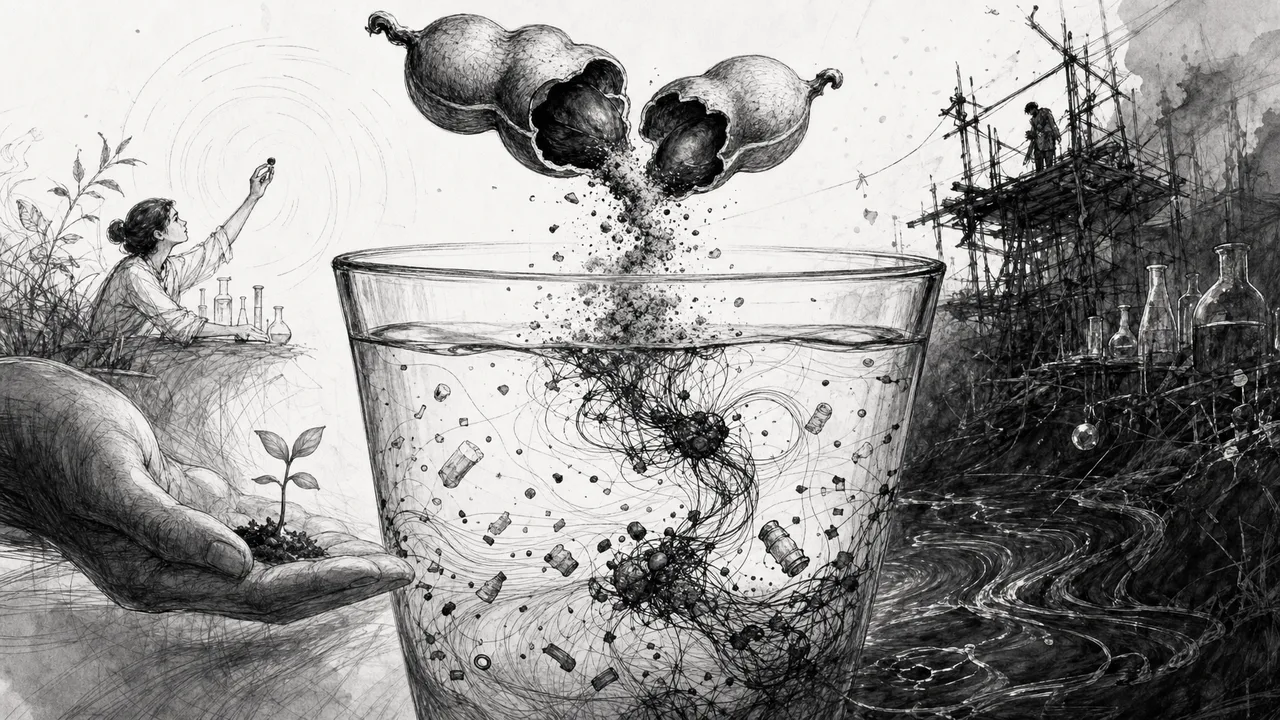
TLDR: Three Indian teenagers won the Asia regional Earth Prize 2026 for Plas-Stick, a low-cost, biodegradable tamarind-seed powder that clumps microplastics so they can be removed from water — a promising idea for rural, low-resource settings. But the bigger story is the gap between clever prototype and trusted drinking-water tool: Plas-Stick still needs independent validation, safety testing, and proof it can work consistently at scale.
Tamarind seed powder. Microplastics. A magnet.
If your brain just did a double take, good. That combination sounds less like water treatment and more like a science-fair table that wandered into the future. But the story is real: three Indian teenagers, Vivaan Chhawchharia, Ariana Agarwal, and Avyana Mehta, won the Asia regional Earth Prize 2026 for Plas-Stick, a biodegradable powder made from waste tamarind seeds designed to clump microplastics so they can be pulled out of water.
You can see why the idea spread. It sounds low-cost, local, and almost elegantly simple. The team built it for shared water containers and low-resource rural communities, no electricity or complex infrastructure required. They worked with researchers at IIT Guwahati and walked away with a $12,500 regional prize from a Swiss nonprofit that runs one of the bigger youth environmental competitions going.
None of that makes it ready for your drinking glass. As of June 2026, Plas-Stick remains in development and has not gone through large-scale independent validation. That gap is the real story. The question is not whether the idea is clever. It is. The question is what it takes for a clever idea to earn the status of trusted drinking-water infrastructure.
Why This Story Has Headline Gravity
Some inventions arrive with built-in appeal, and this one checks every box. Teen inventors tackling microplastics with agricultural waste hits the kind of sweet spot readers reach for when global problems feel too enormous to touch.
It also helps that tamarind seeds feel tangible. You can picture them. You can picture a shared water container in a rural village, someone adding a pinch of powder. That graspability matters when most pollution coverage lives at the scale of vast systems and quiet despair.
The credibility markers add something real. Earth Prize recognition signals that adults with expertise took the project seriously. Collaboration with IIT Guwahati means the students didn't wing this with good intentions and a blender.
Awards and mentorship don't prove readiness, though. The harder middle chapter between beautiful prototype and public utility tends to get left out of coverage.
So: how is tamarind seed powder supposed to do this?
The Mechanism, in Plain English
Microplastics are tiny plastic particles that turn up in water, soil, food, and human bodies with enough regularity to make people uncomfortable for very good reasons.
Plas-Stick uses tamarind seed powder as a flocculant. That means it encourages tiny particles to clump into bigger ones that are easier to remove. Think of the difference between picking individual dust particles out of the air versus lifting a lint ball off your sweater. Same substance, different scale of problem.
The chemistry behind this isn't magic. Tamarind seeds contain water-soluble polysaccharides, long-chain natural molecules that adsorb onto particle surfaces and bridge them together into larger aggregates.
The choice of tamarind matters beyond the chemistry. The seeds are agricultural waste, low-cost, biodegradable, and locally available across India. For a tool aimed at low-resource settings, the input material matters nearly as much as the mechanism.
The murkiest part in public reporting is the magnetic-removal step. Multiple outlets say users can pull out the clumped material with a handheld magnet, but none explain that step in enough technical detail to treat it as fully established. Worth tracking in future coverage.
Why This Isn't Just a Great Headline
The science backing the general approach is real. A 2025 American Chemical Society study tested tamarind seed extract alongside other plant-based materials and found it could act as an effective flocculant for microplastics under laboratory conditions, sometimes performing comparably to synthetic agents. A 2026 Springer study tested tamarind seed extract as a coagulant aid with alum and reported 95 to 98 percent removal of polyamide microplastics across river water, lake water, tap water, and municipal wastewater in controlled testing.
Those findings don't independently validate Plas-Stick. They confirm that tamarind-based flocculation is a legitimate lane of scientific inquiry. The students are working in territory that trained researchers have found worth exploring. That distinction matters.
The Gap Between "Clever" and "Trusted"
Getting from a promising student project to drinking-water infrastructure requires a specific and unglamorous kind of work.
Independent labs need to replicate the method outside the inventors' hands. Water conditions vary: a method that performs well in one river matrix can behave differently in lake water, tap water, or wastewater, and any solution aimed at drinking water needs to hold up across that range. The safety question cuts deeper still. Adding anything to drinking water demands proof about what stays behind after treatment. "Natural" is not a toxicology report.
Then comes scale. A small demo and a repeatable treatment process are different problems entirely. Standardizing sourcing, processing, storage, shelf life, training, and quality control is slower than winning an award and harder to make legible to the public.
Public-health trust may be the steepest hurdle. Communities and health officials adopt a water treatment method when they have evidence they can interrogate, audit, and challenge over time. A compelling origin story earns attention. It doesn't substitute for that evidence.
What Progress Actually Looks Like
The next chapter for Plas-Stick involves work that doesn't trend. Third-party lab replication. Testing across water types and contamination levels. A clearer public explanation of the magnetic-removal step. Safety assessments for drinking-water use. Small pilots before any broader deployment claims.
That kind of progress is slower and less celebratory than an Earth Prize. It's also the only path to public benefit that holds.
The Part Worth Celebrating
Vivaan, Ariana, and Avyana did something real. They built an inventive, low-cost approach to a genuine problem, earned serious mentorship along the way, and drew more than 8,000 students and teachers into a conversation about microplastics pollution. The curiosity they ignited has value independent of where the science eventually settles.
The most useful next step for Plas-Stick isn't another headline. It's rigorous testing, the kind that either confirms what the prize recognized or reshapes the idea into something that works at scale. For a promising invention, that's not a setback. It's the actual job.