Space
-
The Moon Is Still Wrinkling. Scientists Just Mapped 1,100 New Fault Lines.
TLDR: The Moon is actively shrinking and forming new thrust faults as its interior cools. Scientists discovered 1,114 previously unrecognized ridges averaging just 124 million years old—formed while dinosaurs roamed Earth—expanding the map of seismic hazards near the lunar south pole where NASA plans to land. Most of us grew up picturing the Moon as… read more
-
The Goth Lemon of PSR J2322-2650b: Why the Universe’s Most Bizarre Planet Shouldn’t Exist
TLDR: While headlines focus on its unique lemon shape, the real significance of exoplanet PSR J2322-2650b lies in an impossible carbon-dominated atmosphere that contradicts every existing model of planetary formation. This discovery forces a fundamental rethink of how worlds You've probably seen the headlines: astronomers discover a lemon-shaped planet. Cue the viral tweets, the fruit… read more
-
How Did a Wheelchair User Fly to Space—And What Did We Miss in the Headlines?
When Michaela Benthaus felt gravity release its grip 100 kilometers above Texas, she did what any first-time astronaut might do: she tried to flip upside down. For three to four minutes inside Blue Origin's capsule, she floated weightless with five crewmates, watching Earth curve below through windows designed for exactly this view. The headlines wrote… read more
-
The Interstellar Comet That’s Speeding Up, Turning Blue, and Ditching Its Tail—Why Scientists Are Thrilled and Puzzled
Imagine a cosmic visitor that defies expectations at every turn: accelerating when physics says it shouldn't, glowing an alien blue instead of the expected red, and sporting a tail that points the wrong direction. That's 3I/ATLAS right now—our third confirmed interstellar object, and it's rewriting the rulebook in real time. As of November 11, 2025,… read more
-
The Hidden Peril of Space Junk: How a Suspected Debris Hit Stranded Chinese Astronauts and What It Means for Everyone’s Orbit
Imagine returning to your car after a long workday and finding a mystery dent on the door—no note, no culprit, just uncertainty about whether your ride home is safe. Now imagine that car is your only way back from space, the dent came from debris traveling 27,000 kilometers per hour, and you're 250 miles above… read more

-
Stranded Above the Junkyard: The Space Debris That Trapped China’s Astronauts
TLDR: Three Chinese astronauts are stuck in orbit after a marble-sized piece of space debris—traveling at 17× the speed of sound—struck their return capsule, forcing an indefinite delay while engineers decide if it’s safe to fly home; the incident spotlights the 900,000-plus untracked shards now turning low-Earth orbit into a cosmic shooting gallery and the… read more
-
A Eulogy for Lost Wonders: Bill Nye’s Warning on NASA’s Budget Squeeze
A Eulogy for Lost Wonders: Bill Nye's Warning on NASA's Budget Squeeze TLDR: Bill Nye, the Science Guy himself, is out there protesting NASA's proposed budget cuts, calling them an "extinction-level event" for space exploration. We're talking about slashing funds that could doom 41 missions, from hunting for life on Mars to probing icy ocean… read more
-
When the Sky Is Too Interesting: Rubin Observatory’s 10-Million-Alerts-a-Night Problem
TLDR: Rubin will generate approximately 10 million alerts nightly—ten times current surveys. The bottleneck isn’t the telescope’s ability to see the universe; it’s the “plumbing” deciding what deserves follow-up. Seven specialized alert brokers, armed with filters and machine learning classifiers, will sift that torrent for events worth precious telescope time. What we discover becomes a… read more
-
Not billiard balls, beanbags: Gaia’s findings challenge our go-to deflection playbook
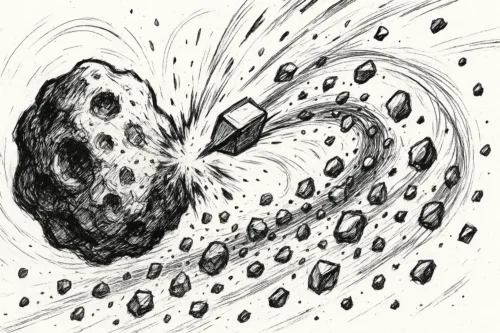
TLDR: Gaia’s massive asteroid dataset reveals a mysterious “gap” in rotation speeds that only makes sense if most asteroids are loose “rubble piles”—floating heaps of gravel, dust, and rock held together by weak gravity, not solid monoliths. This matters because hitting a rubble pile is less like a billiard-ball collision and more like punching a… read more
-
We Read Enceladus’s Ocean by Smashing Snowflakes at 40,000 mph—So What Do “Complex Organics” Actually Mean?
Here’s the gist: In 2008, NASA’s Cassini spacecraft flew through the icy plumes of Saturn’s moon Enceladus and deliberately slammed fresh ice grains into a metal plate at 40,000 miles per hour. A 2025 reanalysis of that collision data confirmed “complex organics”—including esters, ethers, and aromatics. Fantastic news for habitability, but not evidence of life.… read more